
Phonetone Home RV Signal Booster
3.8Editor score
Up to 4000 sq ft coverage
70dB maximum signal gain
Easy plug and play setup
Compare the top 4G and 5G booster for RV models for reliable connectivity on the road with expert reviews and detailed specifications for 2026.
Stay connected on the road with the right 4G and 5G booster for RV to ensure reliable signal in remote areas.
We analyzed the top models based on gain, compatibility, installation ease, and real-world performance to help you choose.
Each pick highlights key features and trade-offs so you can find the perfect fit for your vehicle and budget today.
3.8Editor score

4.4Editor score

4.0Editor score
This side-by-side comparison highlights key specifications for each booster to help you identify the best fit for your specific travel needs.


The PRACOA Vehicle Cell Phone Signal Booster earns our top spot for its robust support of all US carriers and strong 5G capabilities. With a 65dB gain, it significantly amplifies weak signals in rural areas, ensuring reliable calls and streaming while you travel.
We may earn a commission when you buy through this link, at no additional cost to you.
Its standout quality is versatility, supporting a wide range of bands including 2, 4, 5, 12, 13, 17, 25, and 66. This compatibility ensures that whether you use Verizon, AT&T, or T-Mobile, the booster adapts to the available signal to deliver consistent performance.
While the setup is generally straightforward, optimal results depend on finding a spot with at least one bar of external signal. Indoor placement of the antenna also affects coverage distribution across your RV or vehicle interior.
This unit is ideal for families or groups using different carriers who need dependable connectivity on road trips. Its automatic gain control ensures stable performance even as you move through varying signal conditions, making it a top pick for modern RVers.
Supports Verizon, AT&T, T-Mobile, and others across 5G and 4G LTE bands.
Automatic Gain Control adjusts power levels to prevent interference and maintain stability.
We may earn a commission when you buy through this link, at no additional cost to you.
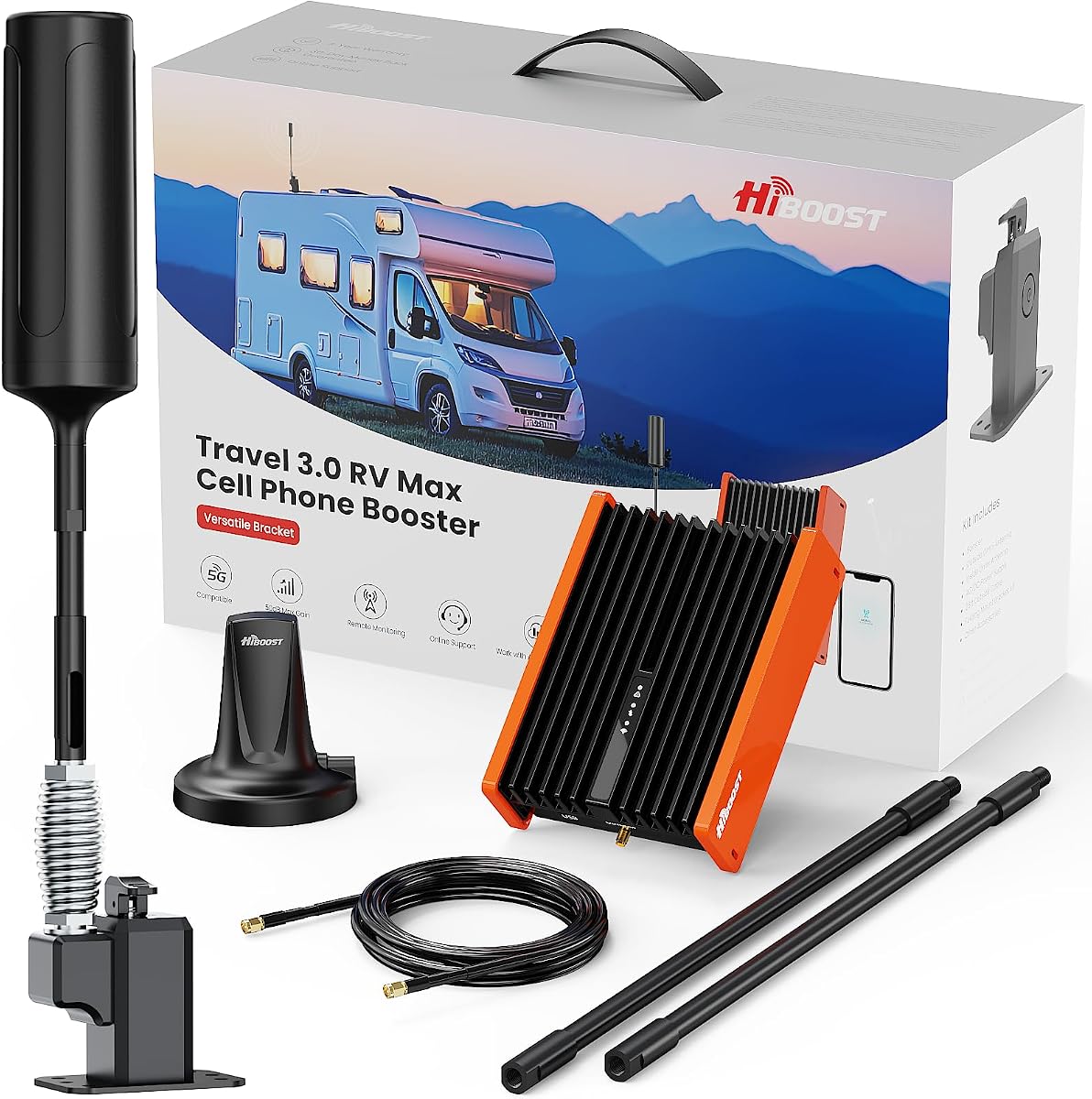
The HiBoost Travel 3.0 RV Max stands out for its flexible installation options, particularly the 180-degree foldable outdoor antenna. This feature is perfect for campers who park in covered lots or garages where height clearance is limited.
We may earn a commission when you buy through this link, at no additional cost to you.
Its smart app support allows you to monitor signal strength and troubleshoot issues remotely, adding a layer of convenience often missing in other boosters. The dual power supply modes let you run it off a 12V vehicle outlet or a standard wall socket.
The main trade-off is the higher price compared to budget alternatives. Additionally, the magnetic indoor antenna requires a metal surface for mounting, which might limit placement options in some RV interior layouts.
If you frequently park in restricted areas and value app-based monitoring, this unit is worth the investment. It delivers reliable whole-RV coverage and is backed by strong local US customer support.
The 180-degree foldable bracket improves clearance for garages and covered lots.
Use the HiBoost mobile app for installation guides and real-time performance tracking.
We may earn a commission when you buy through this link, at no additional cost to you.
This booster offers exceptional value for stationary RV use with a massive 70dB gain and coverage up to 2500 square feet. It is FCC and IC certified, ensuring it meets all regulatory standards for safe operation across North America.
We may earn a commission when you buy through this link, at no additional cost to you.
Its primary strength lies in its simple DIY installation process, requiring no professional help. The kit includes all necessary brackets and accessories, making it accessible for users with limited technical experience.
While highly effective for parked campers, it is not designed for continuous use while driving. The antenna setup also requires a clear path on the roof, which might be tricky on some RV configurations with obstructions.
For RV owners who mostly stay in one spot or visit campgrounds for extended periods, this unit provides reliable high-speed data and voice service. Its high rating reflects customer satisfaction with its performance and ease of use.
Provides coverage up to 2500 square feet for entire RV interiors.
Certified by FCC and IC to ensure safe and legal operation.
We may earn a commission when you buy through this link, at no additional cost to you.
The Phonetone Home RV Signal Booster offers an affordable entry point for those needing large coverage areas. With a 70dB gain and coverage up to 4000 square feet, it is capable of boosting signals across spacious RVs or even small metal buildings.
We may earn a commission when you buy through this link, at no additional cost to you.
Its 360-degree omnidirectional outdoor antenna eliminates the need for aiming, simplifying setup significantly. The unit supports all major US carriers and includes features like auto gain control and manual gain control for fine-tuning performance.
However, user experiences vary, with some reporting mixed results depending on the initial external signal strength. It requires at least one bar of signal to function effectively, and performance can be inconsistent in extremely remote locations.
If you are on a tight budget and have decent external signal, this booster provides a solid chance at improved indoor connectivity. Its straightforward plug-and-play design makes it accessible for most users.
No aiming required thanks to the 360-degree omnidirectional outdoor antenna.
Auto and manual gain control allow precise adjustments for optimal signal quality.
We may earn a commission when you buy through this link, at no additional cost to you.
The weBoost Drive Reach Overland is specifically designed for off-road vehicles and adventurers who need reliability in harsh conditions. Its tough outdoor antenna and versatile mounting bracket ensure it can handle the rigors of off-grid travel.
We may earn a commission when you buy through this link, at no additional cost to you.
Made in the USA, it offers robust FCC compliance and reliable performance on 5G and 4G LTE networks. The 50dB max gain helps extend range significantly, reducing dropped calls in remote zones.
While the gain is slightly lower than some competitors, the durability and brand reputation make up for it. The primary downside is the higher price point compared to generic brands, though quality often justifies the cost.
Overlanding enthusiasts will appreciate the focus on durability and support. If you frequently venture into areas with weak coverage and need a dependable solution, this unit delivers consistent results on the move.
Tough outdoor antenna and mounting bracket built for off-road environments.
US-based customer support and a two-year warranty ensure peace of mind.
We may earn a commission when you buy through this link, at no additional cost to you.
This booster is tailored for truck and RV owners who primarily use AT&T or T-Mobile networks. It offers a powerful 70dB gain and can amplify signals up to 100 times, extending your range by several miles in weak areas.
We may earn a commission when you buy through this link, at no additional cost to you.
The inclusion of a high-resolution LCD screen is a unique feature that displays real-time signal strength, helping you find the optimal antenna placement easily. The durable omnidirectional antenna withstands harsh road conditions.
However, it is not compatible with Verizon Band 13, which limits its universality. Users on Verizon may find performance lacking in areas relying on that specific band. Additionally, initial setup might require some trial and error.
For those who do not rely on Verizon, this unit provides excellent value with lifetime technical support. It is a solid choice for remote travel, ensuring stable connectivity for multiple devices simultaneously.
High-resolution LCD screen displays real-time signal strength for better setup.
Waterproof, shockproof antenna designed for harsh overland environments.
We may earn a commission when you buy through this link, at no additional cost to you.
The HiBoost cell phone signal booster brings modern convenience with both an LCD screen and a dedicated app for signal monitoring. This dual approach helps users fine-tune their installation for maximum performance without guesswork.
We may earn a commission when you buy through this link, at no additional cost to you.
It supports a wide range of frequency bands, ensuring compatibility with major carriers across the US. The included directional antenna allows for longer distance signal reception compared to omnidirectional options.
While the directional antenna requires precise aiming toward the tower, the app simplifies this process. However, if you move locations frequently, the need to reorient the antenna might be a minor inconvenience.
Tech-savvy users will appreciate the feedback mechanisms provided by the app and display. Combined with a strong warranty and local support, this model offers a reliable and controllable connectivity solution.
LCD screen and HiBoost app allow precise installation and real-time tracking.
Directional antenna receives signals from base stations at longer distances.
We may earn a commission when you buy through this link, at no additional cost to you.
This affordable booster offers impressive coverage up to 2152 square feet with a solid 70dB signal gain. Its aluminum alloy housing ensures durability and protection for internal components in various environments.
We may earn a commission when you buy through this link, at no additional cost to you.
The 360-degree cannon barrel antenna receives signals from all directions, distributing them evenly throughout the indoor space. The clear English manual makes installation accessible even for beginners.
User ratings are perfect, indicating high satisfaction with performance. However, generic brands may have less consistent customer support compared to established names. The unit also relies on a strong external signal to function optimally.
For those seeking a budget-friendly yet effective solution for home or stationary RV use, this is a strong contender. Its robust build and wide compatibility make it a practical choice for many travelers.
High-class aluminum alloy housing resists wear and impact for longer life.
Works with Verizon, AT&T, Sprint, and U.S. Cellular across multiple bands.
We may earn a commission when you buy through this link, at no additional cost to you.
This unit stands out with its 2-in-1 design that integrates the indoor antenna into the main body. This eliminates the need for separate indoor antennas and cluttered cables inside your cabin or vehicle dashboard.
We may earn a commission when you buy through this link, at no additional cost to you.
The fiberglass omni-antenna is heavy-duty and designed to withstand wind and brush scrapes during off-road adventures. Smart AGC technology protects cellular towers by preventing oscillation and adjusting power levels automatically.
While convenient, the 50dB gain is slightly lower than top-tier competitors. Additionally, FCC regulations require registration with wireless providers, adding a step to the setup process.
Ideal for fleet vehicles or those valuing neat installation, this booster offers practical utility. If you prioritize cable management and durable outdoor components, this model delivers a straightforward connectivity solution.
Integrated indoor antenna reduces clutter by 50 percent compared to traditional boosters.
Automatic Gain Control prevents interference and protects tower signals.
We may earn a commission when you buy through this link, at no additional cost to you.
The weBoost Destination RV is engineered for stationary use at campgrounds and remote sites. It supports the latest 5G and 4G LTE technologies, delivering high-speed data for streaming and multiple users simultaneously.
We may earn a commission when you buy through this link, at no additional cost to you.
The included directional antenna is designed for parked use, allowing quick 10-minute setup and takedown. As a US-made product with FCC approval, it meets high standards for performance and regulatory compliance.
While the premium price point is higher, the quality and support justify it for serious RVers. Setup is straightforward via the weBoost app, though frequent travelers should note it is optimized for stationary scenarios.
If you prioritize reliability and speed during extended stays, this model excels. Its strong customer support and build quality make it a top choice for those investing in premium stationary connectivity.
Directional antenna allows 10-minute setup and takedown for campsite use.
Supports all US and Canadian carriers for seamless cross-border travel.
We may earn a commission when you buy through this link, at no additional cost to you.
Choosing the right 4G and 5G booster for RV requires understanding key factors like gain, bands, and antenna type to ensure reliable connectivity on the road.
Signal gain measures how much the booster amplifies incoming signals. Higher gain models boost weaker signals further but cost more. Look for at least 50dB for remote areas and 70dB for very weak zones.
Prioritize high gain if you frequently travel to remote spots with barely any external signal.
Different boosters support different frequency bands used by Verizon, AT&T, T-Mobile, and others. Ensure the booster covers the bands your carrier uses, like Band 13 for Verizon or Band 12/17 for others.
Check carrier bands in your area before purchasing to avoid compatibility issues during travel.
Omni-directional antennas receive signals from all directions but are less sensitive. Directional antennas aim at towers for better range but require manual aiming and stability.
Use omnidirectional for moving vehicles and directional for stationary setups or extreme remote areas.
Coverage area depends on the booster's power and antenna placement. A typical booster covers 2000 to 4000 square feet. Larger RVs may need multiple indoor antennas or higher power units.
Match coverage size to your vehicle layout to avoid dead zones inside your living space.
Installation ranges from plug-and-play to professional mounting. Some units require roof drilling and coax cable routing. Look for kits with clear manuals and included accessories to simplify DIY setup.
Choose plug-and-play models if you want minimal effort and no permanent modifications to your RV.
Ensure the booster is FCC and IC certified to comply with laws. Non-compliant units can interfere with networks and cause legal issues. Always verify certifications before buying.
Certified models ensure safe, legal operation without risking interference or fines from authorities.
Prices vary widely from under $200 to over $600 depending on brand and features. Longer warranties like three years offer better protection against defects and failures.
Balance budget needs with warranty length to ensure long-term value and reliability.
Advanced models include LCD screens or apps for monitoring signal strength. This helps optimize placement and troubleshoot issues quickly. Standard units may lack these diagnostic tools entirely.
Consider monitoring features if you need precise control over your signal quality and setup process.
Mount the outdoor antenna on the roof as high as possible with clear view of cell towers. Avoid mounting near other antennas or metal obstructions that block signals.
Route coax cables through your RV carefully, sealing entry points to prevent leaks. Keep cables away from sharp edges that might cut them during travel or maintenance.
Regularly check connections and clean the outdoor antenna to remove dust and debris. Keep software and firmware updated via any app support to maintain optimal performance.
Yes, a booster requires at least one bar of external signal to amplify. Without any signal outside, the booster cannot create data out of thin air.
Most are designed for stationary use, but some models support motion. Check product specs to ensure it is approved for vehicle movement.
For weak rural areas, look for 65dB to 70dB gain. In decent signal zones, 50dB might suffice for reliable connectivity.
Yes, using non-certified boosters can interfere with networks and may lead to fines. Always ensure FCC approval before installation.
Boosters are typically vehicle-specific. Covering multiple vehicles requires separate units or a centralized system for all connected devices.
Many kits are designed for DIY with clear instructions. However, complex setups may benefit from professional help for cable routing.
No, a proper booster speeds up data by strengthening weak signals. It should not reduce speeds unless improperly installed or faulty.
Boosters often include auto gain control to prevent overpowering. If needed, manually reduce gain via settings or adjust antenna placement.
Our top picks for the best 4G and 5G booster for RV include the PRACOA Vehicle Cell Phone Signal Booster for overall value, HiBoost Travel 3.0 RV Max for flexible design, and weBoost Destination RV for stationary needs.
When selecting a booster, prioritize carrier compatibility, signal gain for your typical travel zones, and antenna type based on whether you move or park often.
Always verify current pricing and reviews since models evolve quickly. Investing in the right solution ensures you stay connected and safe wherever your RV adventures take you.