
Entina Tina2C 3D Printer
4.4Editor score
Start in 8 minutes
Compact mini footprint
WiFi and offline modes
Discover the top 3D printer for kids options compared by experts. We evaluate safety, speed, AI features, and ease of use to find the best model for young
Choosing the right 3D printer for kids requires balancing safety, ease of use, and educational value. Modern models often feature enclosed chambers and AI tools to simplify design, making them perfect for sparking creativity and STEM learning at home without overwhelming young users.
We compared ten leading options based on print quality, speed, safety certifications, and software features. Our analysis focuses on models that offer intuitive setups, reliable performance, and engaging libraries of pre-designed projects to ensure every printing session is fun and successful for children and parents.
Each pick highlights specific strengths like AI design assistance, quiet operation, or compact size. Please note that prices and availability change frequently. We recommend checking current listings before purchasing to ensure you get the best deal for your family's creative needs.
4.4Editor score

4.5Editor score

5.0Editor score
This side-by-side comparison highlights key specifications across all ten selected models. Use this table to quickly identify which printer matches your budget, space constraints, and desired feature set for home or classroom use.


The AOSEED AI 3D Printer stands out as a top choice for families wanting to bring 3D printing into the home. With a strong 4.5-star rating, it combines safety features like an enclosed chamber with powerful AI tools that let kids create models from voice or text prompts.
We may earn a commission when you buy through this link, at no additional cost to you.
Its standout quality is the ease of creativity. Features like AI Doodle and AI MiniMe transform simple inputs into 3D files, removing the need for complex CAD skills. The fast 400mm/s speed and real-time camera monitoring keep young users engaged throughout the process.
While it supports only single-color printing, users can create multi-color designs by assembling separate parts. This minor limitation is often outweighed by the educational value and the sheer number of pre-tested models available in its library.
This printer is ideal for parents seeking a comprehensive STEM gift. It offers a balanced mix of safety, speed, and creative software, making it a reliable choice for children aged nine and up who want to explore design and engineering.
Children can use voice or text to generate custom models without learning complex design software, fostering creativity and confidence in their artistic abilities.
The enclosed design protects hands from hot parts, while fast speeds ensure projects finish quickly, keeping interest levels high during the printing process.
We may earn a commission when you buy through this link, at no additional cost to you.
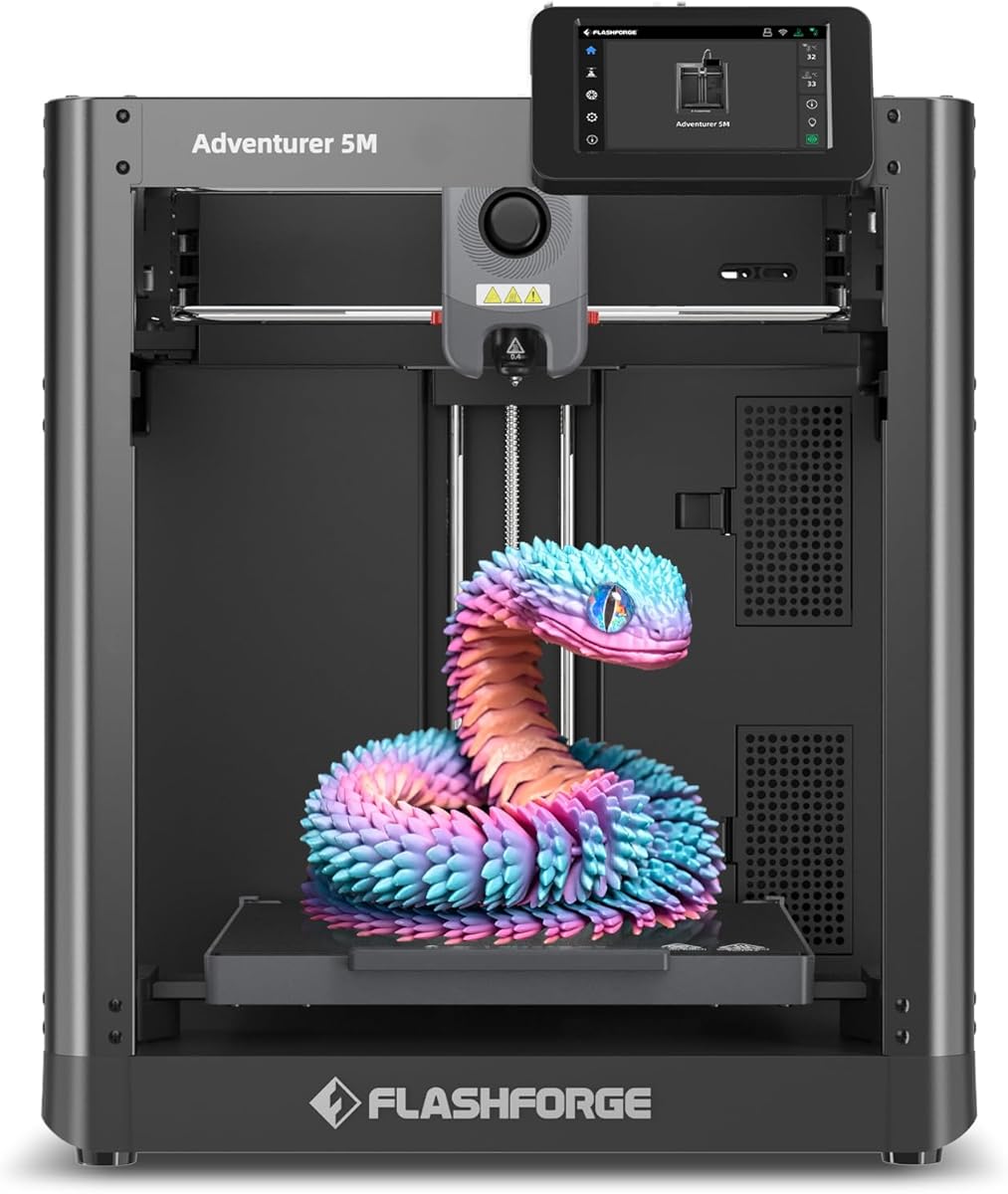
The FLASHFORGE Adventurer 5M offers professional-grade speed and precision, appealing to older kids or tech-savvy parents. Its CoreXY structure and high acceleration allow for rapid prototyping, making it suitable for projects requiring quick turnaround times.
We may earn a commission when you buy through this link, at no additional cost to you.
Features like automatic bed leveling and a 280°C extruder ensure consistent results with a wide variety of materials. The quick-release nozzle system minimizes downtime, which is helpful when switching between different project requirements or troubleshooting issues.
However, it lacks the specialized AI design tools found in other models, and the setup may be more complex for younger children. Users might need more experience to fully utilize its advanced settings and capabilities.
This model is best suited for households where speed and print quality are top priorities. It serves well for STEM projects that require detailed parts, provided users are comfortable managing more advanced printer settings.
With a travel speed of 600mm/s, this printer significantly reduces production cycles, allowing for rapid testing of multiple design iterations.
The high-temperature extruder and cooling system support various materials, giving users flexibility to explore beyond standard PLA filaments.
We may earn a commission when you buy through this link, at no additional cost to you.
The Entina Tina2C is designed to remove frustration from the first printing experience. It promises a setup time of just eight minutes and features guided setup through its app, making it ideal for families new to 3D printing.
We may earn a commission when you buy through this link, at no additional cost to you.
Its compact size fits easily on a desk, and the 3000+ model library provides ample inspiration. The auto-leveling system ensures better first-layer adhesion without manual adjustments, which is a common pain point for beginners.
While the print volume is small, it is sufficient for most educational projects and toys. The trade-off is that larger items must be printed in parts, but this can teach valuable lessons about design for assembly.
This printer is perfect for those on a budget who want reliable performance. It offers essential features like WiFi control and power-loss recovery, ensuring a smooth introduction to the world of additive manufacturing.
Guided setup and automatic leveling reduce the technical barrier, allowing children to start creating almost immediately after unboxing.
Regularly updated STEM courses and interactive tools help turn the printer into a learning platform for science and engineering concepts.
We may earn a commission when you buy through this link, at no additional cost to you.
The Magic Jimmy 3D Printer excels at turning imagination into reality through its AI design suite. Its ability to transform photos into cartoon-style figurines makes it incredibly fun for children to create personalized avatars quickly.
We may earn a commission when you buy through this link, at no additional cost to you.
Safety is a major focus with the fully enclosed chamber keeping hot parts away. The fully assembled design means no tools are needed for setup, allowing immediate use once connected to the network.
Some users may find the reliance on the proprietary app limits flexibility compared to open-source alternatives. However, the seamless integration of design and printing makes the process enjoyable for young creators.
This printer is a strong candidate for families prioritizing ease of use and creative freedom. It effectively bridges the gap between digital ideas and physical objects without requiring technical expertise.
AI MiniMe simplifies creating custom characters by using a simple photo as a base, allowing kids to easily customize their own toys.
The enclosed design and lack of assembly requirements ensure that the printer is ready for immediate creative use without complex setup.
We may earn a commission when you buy through this link, at no additional cost to you.
With a perfect 5.0 rating, the AOSEED X-MAKER AI+ delivers a premium experience for families serious about STEM education. It offers ultra-quiet operation, making it suitable for shared spaces where noise might be a concern.
We may earn a commission when you buy through this link, at no additional cost to you.
The inclusion of eight TÜV-tested PLA rolls ensures safety and consistency from the start. Advanced features like power-loss recovery and a touchscreen interface add convenience and reliability to the printing workflow.
While the price is higher than other options, the build quality and included accessories justify the investment. It is designed for longevity and consistent performance, reducing the frustration of failed prints.
This printer is ideal for those who want a top-tier machine with minimal maintenance. It combines safety, speed, and educational value in a polished package that stands out in the market.
The TÜV-tested PLA and robust build ensure safety and print quality, giving parents peace of mind when children are using the device.
Operating under 50 dB, the printer allows for uninterrupted study or creative sessions without the distraction of loud mechanical noise.
We may earn a commission when you buy through this link, at no additional cost to you.
This mini printer offers a complete starter kit at an accessible price point. It is fully assembled and includes essential accessories like filament and an SD card, making it ready to use immediately out of the box.
We may earn a commission when you buy through this link, at no additional cost to you.
Features like one-button auto-leveling and filament loading simplify the process for beginners. The high precision of 0.01mm ensures detailed results, which is impressive for a budget-friendly option.
The compact build volume limits the size of projects but is adequate for most educational models. Users looking for advanced AI tools or large printing areas may need to look elsewhere.
For families seeking a functional entry-level printer without breaking the bank, this model provides excellent value. It balances cost with essential features needed to start learning about 3D printing.
The fully assembled design and included accessories mean users can begin printing right away without needing to buy extra tools or parts.
One-button controls for leveling and loading reduce the technical steps required, making the process less intimidating for new users.
We may earn a commission when you buy through this link, at no additional cost to you.
Another version of the Magic Jimmy printer, this model maintains the strong focus on AI design tools. It offers a safe enclosed chamber and easy setup, ensuring a smooth experience for families entering the 3D printing space.
We may earn a commission when you buy through this link, at no additional cost to you.
The consistent performance and high rating indicate reliability across multiple units. The built-in time-lapse camera helps capture progress, adding a visual layer to the creative process.
While it lacks some advanced features found in newer models, it remains a solid choice for basic creative projects. The focus on safety and simplicity makes it appropriate for younger children.
Families looking for a proven system with minimal fuss will find this model suitable. It provides a straightforward path from digital design to physical creation without unnecessary complexity.
The fully enclosed chamber protects users from moving parts and hot surfaces, ensuring a safe environment for children during printing.
AI tools allow for custom designs based on user ideas, fostering independence and imagination in the creative process.
We may earn a commission when you buy through this link, at no additional cost to you.
This bundle adds four colors of PLA filament to the standard Tina2C package, offering immediate variety for creative projects. The compact design and easy app control make it a practical choice for smaller workspaces.
We may earn a commission when you buy through this link, at no additional cost to you.
Features like auto leveling and power-loss recovery ensure higher success rates, which is vital for maintaining interest among young users. The magnetic build plate simplifies removal, reducing the risk of damage to prints.
While it lacks advanced AI tools, the DIY modules and large model library provide ample content. It is a straightforward system focused on reliability and ease of use.
For households that want a complete package without extra purchases, this bundle offers great value. It combines essential printing capabilities with enough creative material to keep kids engaged for weeks.
The inclusion of four filament colors allows for diverse projects right from the start, encouraging exploration of different color combinations.
Features like power-loss recovery ensure that unexpected interruptions do not ruin ongoing projects, saving time and material for users.
We may earn a commission when you buy through this link, at no additional cost to you.
Focusing on STEM education, this Magic Jimmy model helps develop design thinking and spatial reasoning. The AI suite allows kids to turn ideas into physical objects quickly, reinforcing engineering concepts in a fun way.
We may earn a commission when you buy through this link, at no additional cost to you.
The enclosed design and cool-touch exterior ensure safety during use. The built-in camera captures time-lapse videos, which are excellent for reviewing progress and sharing results with teachers or peers.
The trade-off is limited manual control for advanced users, but this simplicity is intentional for the target audience. It removes technical hurdles to focus on the creative process.
This printer is perfect for classrooms or families prioritizing educational value. It provides a safe and supportive environment for learning about modern manufacturing technologies.
The tools are designed to teach spatial reasoning and problem-solving by allowing users to see their ideas take physical shape.
Time-lapse videos help users visualize the printing process layer by layer, adding an educational element to the creative experience.
We may earn a commission when you buy through this link, at no additional cost to you.
The Bambu Lab A1 mini offers a seamless ecosystem experience with automatic calibration and a large ready-to-print model library. It is designed for beginners who want to focus on creating rather than troubleshooting technical issues.
We may earn a commission when you buy through this link, at no additional cost to you.
The included LED Lamp Kit encourages functional creativity, allowing users to turn prints into practical lighting projects. The Bambu Handy app provides smooth control and management of prints remotely.
While it uses a specific ecosystem that may limit filament choice, the reliability and speed justify the investment for many users. The compact size fits well in home environments.
This printer is suitable for those who prefer a hassle-free experience with high-quality results. It brings professional ease-of-use to the home market, making advanced technology accessible.
The included LED Lamp Kit guides users to create items that serve a purpose, bridging the gap between toys and functional objects.
Automatic calibration removes the complex setup steps, ensuring consistent print quality without requiring user intervention or manual adjustments.
We may earn a commission when you buy through this link, at no additional cost to you.
Choosing the right printer depends on balancing safety, ease of use, and educational features. We break down the key factors to consider when selecting a model for your child's creative needs.
Safety is the most critical factor for children's printers. Look for models with fully enclosed chambers to protect hands from moving parts and hot nozzles. Cool-touch exteriors and non-toxic filaments like PLA are also essential for a safe environment.
Always verify that the printer has safety certifications before purchasing to ensure it meets safety standards for home use.
Beginner-friendly printers should have auto-leveling and quick setup times. Fully assembled models save time and frustration, allowing immediate use. Simple loading mechanisms and clear software interfaces make the process accessible for younger users.
Prioritize printers with guided setup and intuitive controls to reduce the learning curve and ensure a positive first experience.
Modern printers often include AI tools that simplify design. Features like AI Doodle or photo-to-3D converters allow kids to create without learning complex software. A large library of pre-designed models provides instant inspiration and projects.
Check if the printer supports importing external files and offers regular software updates to keep the experience fresh and engaging.
The build volume determines the size of objects you can print at once. For most kids projects, a compact volume is sufficient and saves space. Larger volumes allow for more substantial items but may require more workspace.
Assess your available desk space and the typical project sizes your child wants to create before choosing the build volume size.
Faster printers reduce wait times, keeping young users engaged during the process. Speeds over 200mm/s help complete small toys quickly. However, ensure the printer maintains quality at high speeds to avoid failed prints.
Look for models that balance speed with precision to ensure successful results without excessive delays.
Most kids printers use PLA filament due to its safety and ease of use. Ensure the printer supports standard 1.75mm PLA for easy replacement. Some premium models include filament rolls, which reduces initial costs.
Verify if the printer supports only PLA or allows for other materials if you plan to expand your child's creative options later.
WiFi connectivity and smartphone apps allow parents to monitor prints remotely. Features like built-in cameras and time-lapse recording add value by capturing the process. Remote control helps ensure safety and manage printing times.
Choose models with reliable app support and camera features to keep an eye on progress from another room.
Quiet operation is important for shared spaces. Printers that operate under 50dB allow for use during study time or at night without disruption. Noise levels can affect whether the printer is used frequently.
Check decibel ratings to ensure the printer will not be a distraction in your home environment.
Start by placing the printer on a stable, level surface away from direct sunlight. Connect to WiFi and load the filament according to the guided setup instructions. Ensure the build plate is clean to prevent adhesion issues.
Regularly clean the nozzle and check for dust buildup to maintain print quality. Use the included tools to remove prints gently and avoid damaging the nozzle or plate. Keep firmware updated to access new features and fixes.
Store filament in a cool, dry place to prevent moisture absorption. When not in use, turn off the printer and cover it to protect from dust. Encourage your child to participate in cleaning routines to learn responsibility.
Most 3D printers for kids are recommended for ages 8 and up, provided adult supervision is available. Models with enclosed designs and safety features can be introduced to younger children under direct guidance.
Yes, PLA is generally considered safe because it is biodegradable and emits fewer fumes than other materials. Always ensure the printer is in a well-ventilated area during operation.
No, many modern printers include libraries of pre-made models and AI tools that let you create from text or photos. This removes the need for CAD skills entirely for most projects.
Small toys can take anywhere from 20 minutes to a few hours depending on size and detail. Faster printers reduce this time significantly, keeping engagement levels high.
Most models have power-loss recovery that resumes printing after power is restored. Filament runout detection also pauses the print, allowing you to reload without losing progress.
Yes, these printers are designed for family use. Multiple accounts or user profiles can be set up on the associated apps to track individual project history and progress.
We have reviewed ten excellent options ranging from budget-friendly starters to premium AI-powered models. Each pick offers unique strengths in safety, speed, and creative tools to suit different needs.
Prioritize safety features like enclosed chambers and ease of use for your child's age group. A printer that inspires creativity without frustration is the best investment for long-term engagement.
Prices and availability may change, so check current listings before finalizing your purchase. We hope this guide helps you find the perfect 3D printer for your family's creative journey.