
Mcbazel 3 in 1 Handheld Digital Anemometer
4.5Editor score
Beaufort scale display
MAX/MIN/AVG functions
Double-line LCD screen
This guide compares the top anemometer for measuring wind speed to help you find the best wind meter for HVAC, sailing, drone flying, and outdoor activities.
Finding the right anemometer for measuring wind speed is essential for professionals and enthusiasts alike. Whether you work in HVAC, sail boats, fly drones, or monitor weather conditions, accurate wind data ensures safety and efficiency. A quality device provides reliable readings across multiple units and environmental conditions.
We evaluated ten leading models based on accuracy, durability, display quality, and ease of use. Our comparison considers wind speed ranges, temperature sensors, battery life, and additional features like CFM calculation and tripod mounting. Each product offers unique strengths for specific applications and budgets.
Every pick highlights key specs, pros, cons, and ideal use cases to guide your decision. Note that prices and availability change frequently, so verify current details before purchasing. This expert guide ensures you select an anemometer for measuring wind speed that fits your needs perfectly.
4.5Editor score

4.5Editor score

4.6Editor score
This side-by-side comparison highlights key specifications and features across all ten products. Review each model to find the best fit for your specific wind measurement needs.



The BTMETER BT-100 stands out as a top choice for measuring wind speed with its high accuracy and versatile unit options. With a rating of 4.5 stars, users praise its reliable performance across HVAC and outdoor applications. Its 0.67 to 67.1 mph range covers most common scenarios efficiently.
We may earn a commission when you buy through this link, at no additional cost to you.
Key strengths include the tripod mounting hole, which allows for steady measurements without holding the device. The bright backlit LCD ensures visibility in low light, and the five speed units (m/s, km/h, ft/min, knots, mph) offer flexibility for international use. Wind temperature and chill readings add value.
Trade-offs include the plastic casing, which may feel less rugged than metal alternatives, and the absence of a humidity sensor. These are acceptable for the price point and focused functionality. Most users prioritize accuracy and unit variety over added sensors.
Buy this if you need a dependable wind meter for HVAC, drone flying, or sailing. It balances performance and portability well. Recommended for professionals and hobbyists seeking reliable data without excessive cost.
The BT-100 offers five wind speed units plus temperature, ensuring flexibility for global users and diverse applications without extra tools.
A threaded tripod hole enables continuous monitoring hands-free, ideal for long-term HVAC checks or drone launch sites.
We may earn a commission when you buy through this link, at no additional cost to you.
The Mcbazel 3 in 1 delivers impressive value as a budget-friendly anemometer without sacrificing core functionality. With 4.5 stars, it meets needs for HVAC, sailing, and fishing. Its triple measurement capabilities cover wind speed, temperature, and wind level effectively.
We may earn a commission when you buy through this link, at no additional cost to you.
Standout features include the Beaufort scale for quick wind level assessment and the double-line LCD showing speed and temperature simultaneously. MAX/MIN/AVG functions aid data tracking. The backlight ensures readability in dim environments like indoor ducts.
Drawbacks involve missing batteries and simpler build quality compared to premium models. These are minor issues for budget shoppers. Performance remains reliable for casual and semi-professional tasks.
Choose this for cost-effective wind monitoring at home or work. It suits hobbyists and general users needing accurate, portable tools. Ideal for entry-level HVAC techs or outdoor enthusiasts.
The 1-12 Beaufort scale provides instant wind force context, useful for sailors and sailors without complex calculations.
View wind speed and temperature together on the double-line LCD for faster decision-making in the field.
We may earn a commission when you buy through this link, at no additional cost to you.
The Caldwell Wind Wizard II earns top premium status with exceptional durability and a lifetime warranty. At 4.6 stars, it excels in shooting and hunting environments where reliability is critical. Its water-resistant design handles diverse weather conditions effortlessly.
We may earn a commission when you buy through this link, at no additional cost to you.
Strengths include the ergonomic non-slip rubber casing for secure handling, and the multiple unit options (mph, ft/min, km/h, m/s, knots). The backlight aids night use. Battery auto-off conserves power during idle periods.
The main trade-off is the higher price and lack of CFM calculation, which matters less for shooting. Durability justifies the cost for professionals needing long-term tools.
Buy this for serious outdoor activities requiring rugged, accurate meters. It fits hunters and shooters prioritizing longevity. Recommended for users seeking warranty-backed investment.
Water-resistant materials ensure consistent performance in rain or humidity, essential for extended outdoor missions.
Caldwell backs this model with a limited lifetime warranty, offering peace of mind for heavy-duty use.
We may earn a commission when you buy through this link, at no additional cost to you.
The TopTes TS-301 offers a standout 2.26-inch LCD for effortless reading across outdoor activities. At 4.5 stars, it balances features like humidity and temperature sensing with portability. Ideal for sailing and golf where quick data is vital.
We may earn a commission when you buy through this link, at no additional cost to you.
Its large backlight screen ensures clarity in varied lighting, while humidity and temp sensors provide comprehensive weather data. Auto power-off at 10 minutes saves battery. Included batteries and pouch add convenience.
The sensor may take 30 minutes to adjust to new environments, delaying instant accuracy. Plastic build limits ruggedness. These minor issues suit general users prioritizing display quality.
Choose this for activities needing clear, multi-parameter readings. Perfect for hobbyists and outdoor sports. Recommended for easy use and visibility.
The 2.26-inch LCD with backlight provides immediate visibility, reducing eye strain during extended field use.
Humidity and temperature sensors enable comprehensive environmental assessment, useful for planning activities or HVAC checks.
We may earn a commission when you buy through this link, at no additional cost to you.
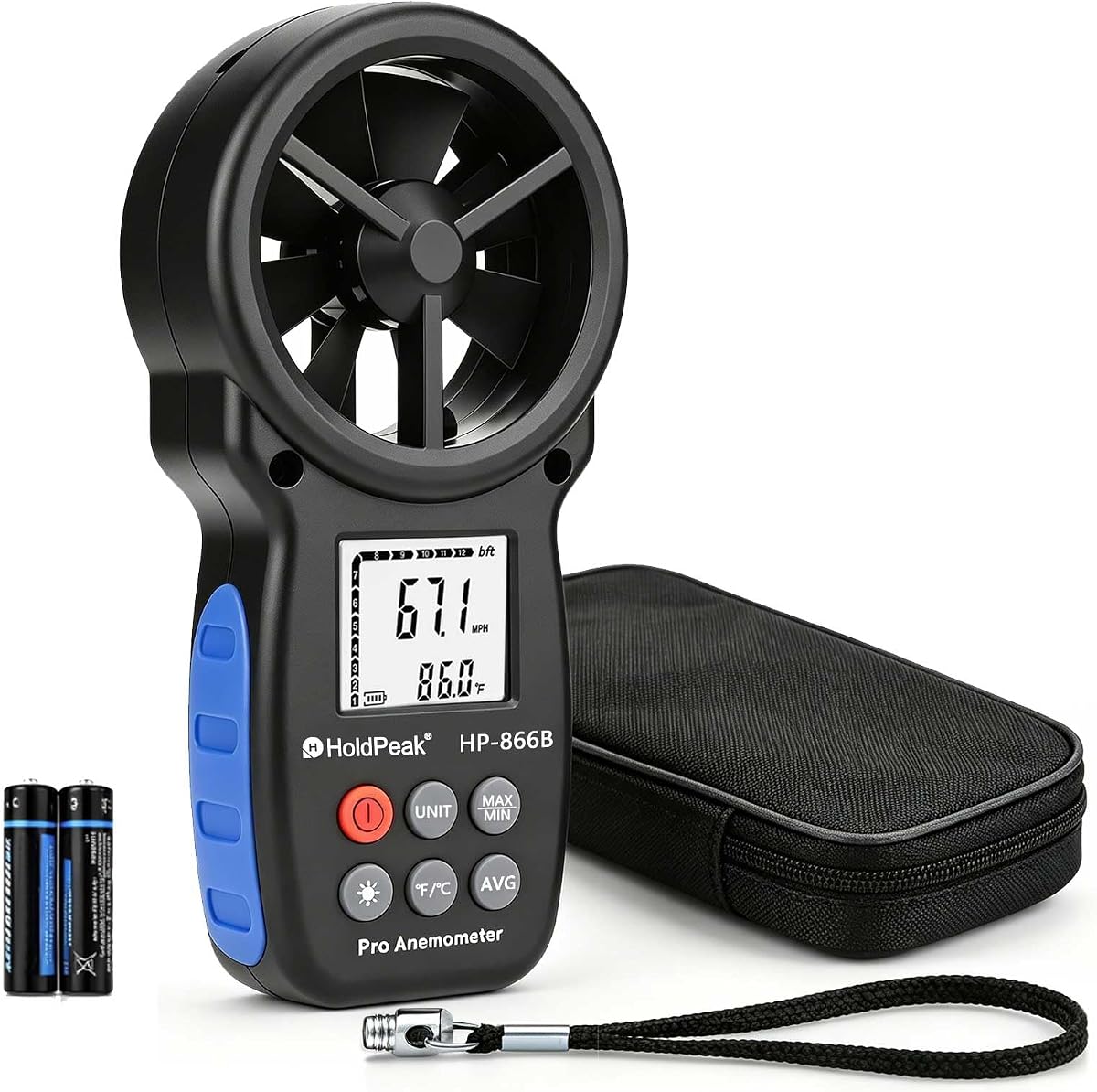
The HoldPeak 866B excels in HVAC applications with its CFM calculation helper. At 4.5 stars, it delivers precise wind and temperature readings for duct ventilation. Its dual sensors improve accuracy for low air flow measurements.
We may earn a commission when you buy through this link, at no additional cost to you.
Standout features include the tripod hole for stability during long checks and the waterproof carrying pouch for protection. Max/Min/Average modes aid tracking. Auto-off preserves battery life.
The device weighs slightly more than some rivals, and the display is standard size. These are acceptable trade-offs for HVAC specialists needing calculation aids.
Buy this for duct work, ventilation systems, or industrial airflow checks. Ideal for technicians prioritizing CFM data. Recommended for professional HVAC use.
The built-in helper calculates CFM from wind speed and area, streamlining HVAC diagnostics without external tools.
A waterproof carrying pouch shields the device from damage during transport to job sites.
We may earn a commission when you buy through this link, at no additional cost to you.
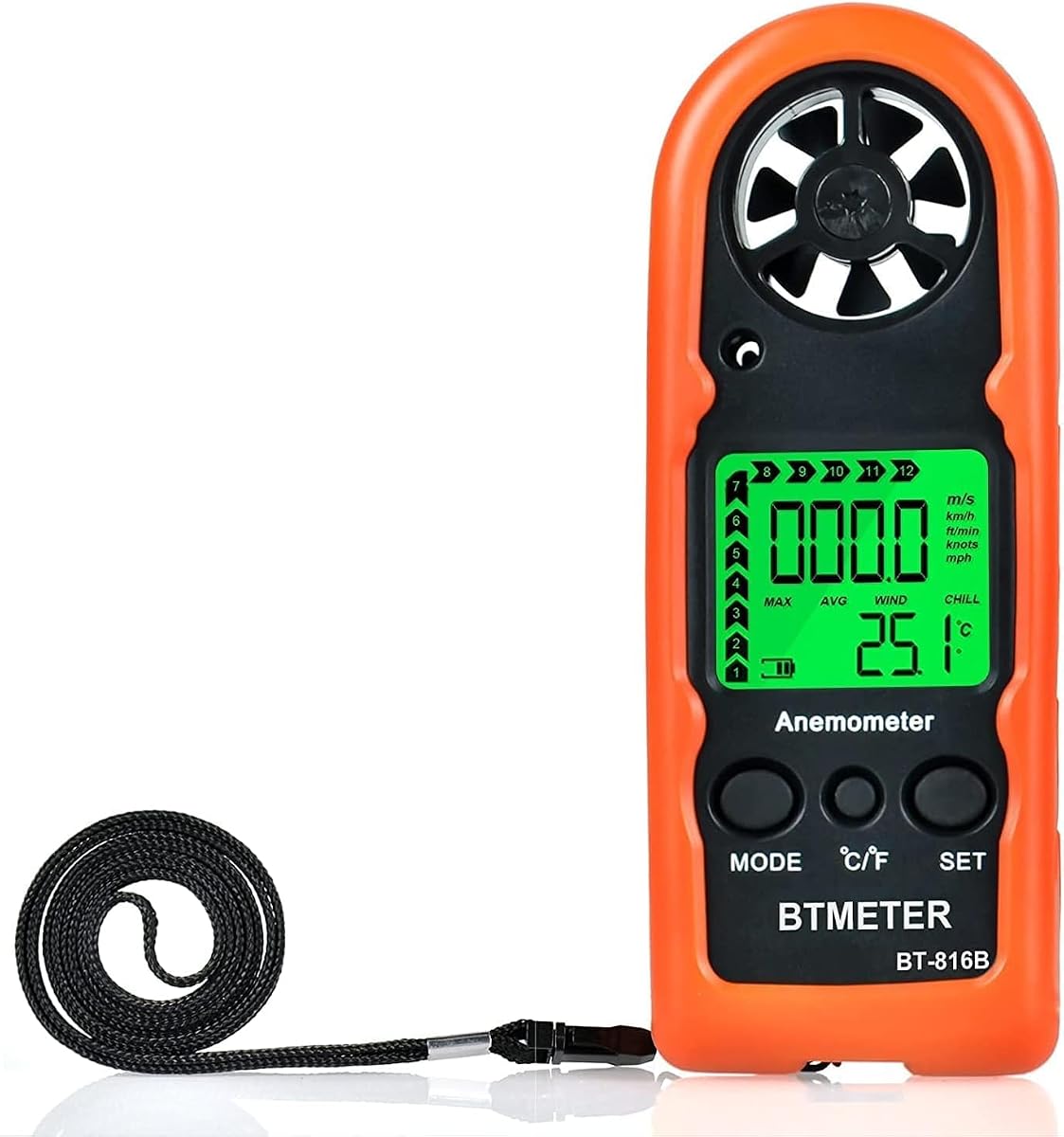
The BTMETER BT-816B is a compact lightweight option ideal for travel and outdoor activities. At 4.3 stars, it offers wind chill and multiple unit options in a tiny form. Its 53g weight makes it easy to carry.
We may earn a commission when you buy through this link, at no additional cost to you.
Key features include wind chill for safety assessment, manual/auto power modes, and a lanyard. The range covers 0.2 to 67 mph, suitable for most needs. Battery indicator prevents unexpected shutdowns.
Accuracy is ±5%, slightly less than rivals, and lacks a tripod mount. These are acceptable for casual users prioritizing portability over precision.
Choose this for hiking, sailing, or quick checks. Best for general users needing a pocket-sized tool. Recommended for travelers.
Weighing only 53 grams, this meter slips easily into pockets for impromptu measurements during hikes or trips.
Real-time wind chill readings help assess environmental risk during outdoor activities like shooting or climbing.
We may earn a commission when you buy through this link, at no additional cost to you.
The Soonkoda 3 in 1 targets industrial and HVAC use with a wide measurement range starting at 0.06 m/s. At 4.3 stars, it offers triple functions for detailed airflow analysis. The double-line display shows speed and temperature clearly.
We may earn a commission when you buy through this link, at no additional cost to you.
Features include Beaufort scale for wind levels, auto power-off, and a low-battery indicator. Its design suits duct ventilation, petrochemical, and power industries where precision is key.
The unit resolution is standard, and build is plastic. These are minor drawbacks for professional-grade pricing. It excels in specialized settings.
Buy this for industrial, HVAC, or aviation applications needing wide-range data. Ideal for technicians. Recommended for specialized monitoring.
Starting at 0.06 m/s, this meter detects very low air flows critical for sensitive HVAC and underground system checks.
Designed for sectors like aviation and petrochemical, ensuring reliability in demanding environments.
We may earn a commission when you buy through this link, at no additional cost to you.
The AEM01S POROMETISTO features a unique 3-color alarm backlight indicating safety levels. At 4.5 stars, it ensures quick visual feedback for dangerous conditions. Its ergonomic design fits comfortably in the hand.
We may earn a commission when you buy through this link, at no additional cost to you.
Standout features include color-coded levels: green for safe, orange for caution, red for danger. Sampling every 0.5 seconds ensures real-time reliability. The one-year warranty supports quality assurance.
Unit options are fewer than rivals, and uses standard AAA batteries. These are minor limits for safety-focused users needing instant alerts.
Choose this for drone flying or outdoor activities requiring quick visual wind alerts. Ideal for safety-conscious users. Recommended for field use.
The 3-color backlight instantly communicates wind danger levels, reducing cognitive load during active outdoor sessions.
Sampling every half-second provides timely updates for changing wind conditions, vital for fast-paced tasks.
We may earn a commission when you buy through this link, at no additional cost to you.
The Proster Digital Anemometer is a professional tool with CFM and CMM modes for detailed airflow analysis. At 4.4 stars, it suits HVAC and research work needing precise volumetric data. The 9V battery ensures sustained operation.
We may earn a commission when you buy through this link, at no additional cost to you.
Features include reading hold for stable values, backlight LCD, and five speed units. Its high specs support fixed or handheld use. Ideal for technical environments.
The 9V battery adds weight and the interface can be complex for casual users. These are acceptable for professionals needing volumetric metrics.
Buy this for HVAC diagnostics, research, or industrial airflow checks. Ideal for experts prioritizing CMM data. Recommended for technical applications.
CFM and CMM measurements enable precise volumetric flow analysis, essential for duct sizing and system balancing.
The hold function freezes readings for recording or transfer, improving workflow efficiency in documentation.
We may earn a commission when you buy through this link, at no additional cost to you.
The VEVOR Split Handheld Anemometer enables data logging via USB for PC analysis. At 4.4 stars, it suits professionals needing recorded wind data over time. Its IP44 rating handles rain or snow conditions effectively.
We may earn a commission when you buy through this link, at no additional cost to you.
Features include a 2m extendable cord for remote measurements, LED backlight, and multiple modes (wind velocity, temp, flow). The storage bag protects during transit. Ideal for construction, agriculture, or navigation.
Requires Windows PC for data transfer and is bulkier than simple meters. These are minor trade-offs for users needing historical data and versatility.
Buy this for long-term monitoring, construction, or agriculture projects requiring data export. Ideal for technical teams. Recommended for analysis-focused users.
The USB port connects to PCs for data logging, allowing detailed trend analysis for weather or HVAC tracking.
A 2m cord permits measurements from safer distances, ideal for high airflow or hazardous areas.
We may earn a commission when you buy through this link, at no additional cost to you.
Selecting the right anemometer requires evaluating several factors to match your needs. This guide explains key aspects to consider for optimal performance and value.
Ensure the device covers your expected wind speeds. Ranges typically start at 0.2 to 0.7 mph and go up to 100 mph. Accuracy varies from ±2% to ±5%, with professional models offering tighter tolerances for critical work.
Prioritize accuracy if you need precise data for HVAC or research. Casual users can accept ±5% for general checks.
Multiple units like m/s, km/h, mph, and knots provide flexibility. A clear LCD with backlight ensures readability in various lighting. Larger screens reduce eye strain during extended use.
Check for needed units and backlight quality before purchasing to avoid limitations.
Some models include temperature, humidity, and wind chill sensors. These add value for outdoor planning or HVAC. Features like CFM calculation are vital for airflow work.
Choose models with sensors only if you need the data to avoid unnecessary costs.
Water-resistant or waterproof ratings like IP44 protect against elements. Rugged casings with non-slip grips prevent drops. Lifetime warranties signal high durability.
Invest in durable materials if using in harsh or industrial environments.
Auto power-off saves battery during idle times. Battery types vary (AAA, 9V) with impact on weight and replacement. Low-battery indicators prevent unexpected failures.
Look for long battery life or replaceable batteries for uninterrupted field work.
Lightweight designs aid travel. Tripod holes enable stable measurements. Corded or split models allow remote use. Carry pouches protect during transport.
Select portable options for hiking, while tripod support suits professional HVAC checks.
USB or Bluetooth enables data transfer for analysis. This is crucial for research or long-term monitoring. PC compatibility varies by OS.
Choose connected models only if you need to export and analyze historical data.
Prices vary from under $20 to over $50. Budget models may lack premium features. Warranty terms like one-year or lifetime affect long-term value.
Balance cost with expected usage. Warranties protect against defects in professional tools.
To use your anemometer, hold it level with the vanes facing into the wind. Allow the blades to spin freely and wait for readings to stabilize. For tripod mounting, secure the device and position at the desired height. Always check battery levels before starting measurements.
For accurate results, avoid obstructions like walls or trees that block airflow. In HVAC work, insert the probe directly into the duct. For outdoor activities, take multiple readings over time to average fluctuations. Record data using hold functions if available.
Care for your device by storing it in a protective case when not in use. Clean vanes gently with a soft cloth to remove dust. Keep away from extreme heat or moisture unless rated for it. Replace batteries promptly when low indicators appear.
An anemometer measures wind velocity to assist in HVAC testing, weather monitoring, sailing, drone flying, and research. It provides data in multiple units like mph, m/s, or knots, helping users assess conditions for safety or operational purposes.
Handheld anemometers typically offer accuracy within ±2% to ±5% of readings. Professional models may have tighter tolerances for precise work. Factors like calibration and sensor quality affect accuracy, so choose based on your needs.
Not all models include temperature sensors, but many modern ones do. These provide added value by showing wind chill or environmental conditions. Check specifications before purchasing to ensure temperature measurement if required.
Yes, anemometers work indoors for HVAC duct checks or airflow testing. They measure low air velocities in vents. Ensure the range covers low speeds for accurate indoor measurements without obstructions.
Most handheld units are pre-calibrated. For precise work, use a calibration tool or compare against a reference device. Regular checks maintain accuracy, especially for professional applications requiring exact readings.
The Beaufort scale indicates wind force levels from 1 to 12. It helps users quickly assess wind conditions without technical units. It is common in sailing and outdoor activities for intuitive data.
Some models have IP44 or water-resistant ratings, but not all are fully waterproof. Check specs for moisture protection if using in rain. Keep electronics dry to extend device lifespan.
Battery life varies by model, usage, and auto-off settings. Many last hours of active use on AAA batteries. Auto power-off extends life by shutting down after inactivity. Always carry spares for critical field work.
The BTMETER BT-100 leads our picks for its balance of accuracy, unit variety, and tripod mount. Budget buyers will appreciate the Mcbazel 3 in 1, while Caldwell Wind Wizard II offers premium durability. Each model excels in specific scenarios.
Prioritize features that matter most for your application. HVAC needs CFM modes, sailors value Beaufort scales, and researchers need data logging. Match specs to tasks to ensure long-term satisfaction.
Verify current prices and availability before purchasing, as these change frequently. This guide provides a reliable starting point to find the right anemometer for your measuring needs in 2026.