
LAFVIN R3 Camera Smart Robot Car
4.5Editor score
ESP32-S3 Module
WiFi Remote Control
Five Operation Modes
Open Source Code
Discover the top Arduino robot kits for 2026. This guide compares features, compatibility, and educational value to help you choose the right STEM robot for
Arduino robot kits offer an engaging way to learn electronics, coding, and engineering through hands-on assembly. These programmable devices allow users to build functional machines that can move, sense their environment, and interact with the world. Whether you are a student, educator, or hobbyist, finding the right kit depends on your skill level and desired projects.
We evaluated ten leading Arduino-compatible robot kits based on build quality, sensor variety, programming options, and educational value. Our analysis includes detailed comparisons of chassis materials, control methods, and expansion potential. This list covers options for beginners and advanced makers, ensuring there is a suitable choice for every learning path.
Each pick highlights specific strengths like camera integration, tank treads, or robotic arms to help you match a kit to your goals. Prices and availability fluctuate frequently so please verify current details before purchasing. We aim to provide clear, honest insights to guide your investment into robotics and STEM education effectively.
4.5Editor score

4.5Editor score

4.3Editor score
This side-by-side comparison highlights key specifications and capabilities across all ten selected kits to help you make an informed decision quickly.


This kit ranks as our top choice for its balanced feature set and beginner friendly design. It allows users to build a fully programmable car that supports FPV streaming and multiple sensor modes right out of the box.
We may earn a commission when you buy through this link, at no additional cost to you.
The standout quality is the integrated camera module which streams real time video to your phone. This transforms the build into a remote operated vehicle experience that is both fun and educational for students learning robotics.
While the price is higher than basic kits the included camera and sensors justify the cost. The only minor drawback is that users need to provide their own power source for the remote controller.
We recommend this for anyone seeking a complete robotics experience without advanced soldering. It is perfect for weekend projects that grow with your coding skills over time.
The onboard camera provides a clear first person view allowing precise navigation through obstacles.
Keyed connectors prevent wiring errors so beginners can focus on programming logic instead of troubleshooting.
We may earn a commission when you buy through this link, at no additional cost to you.
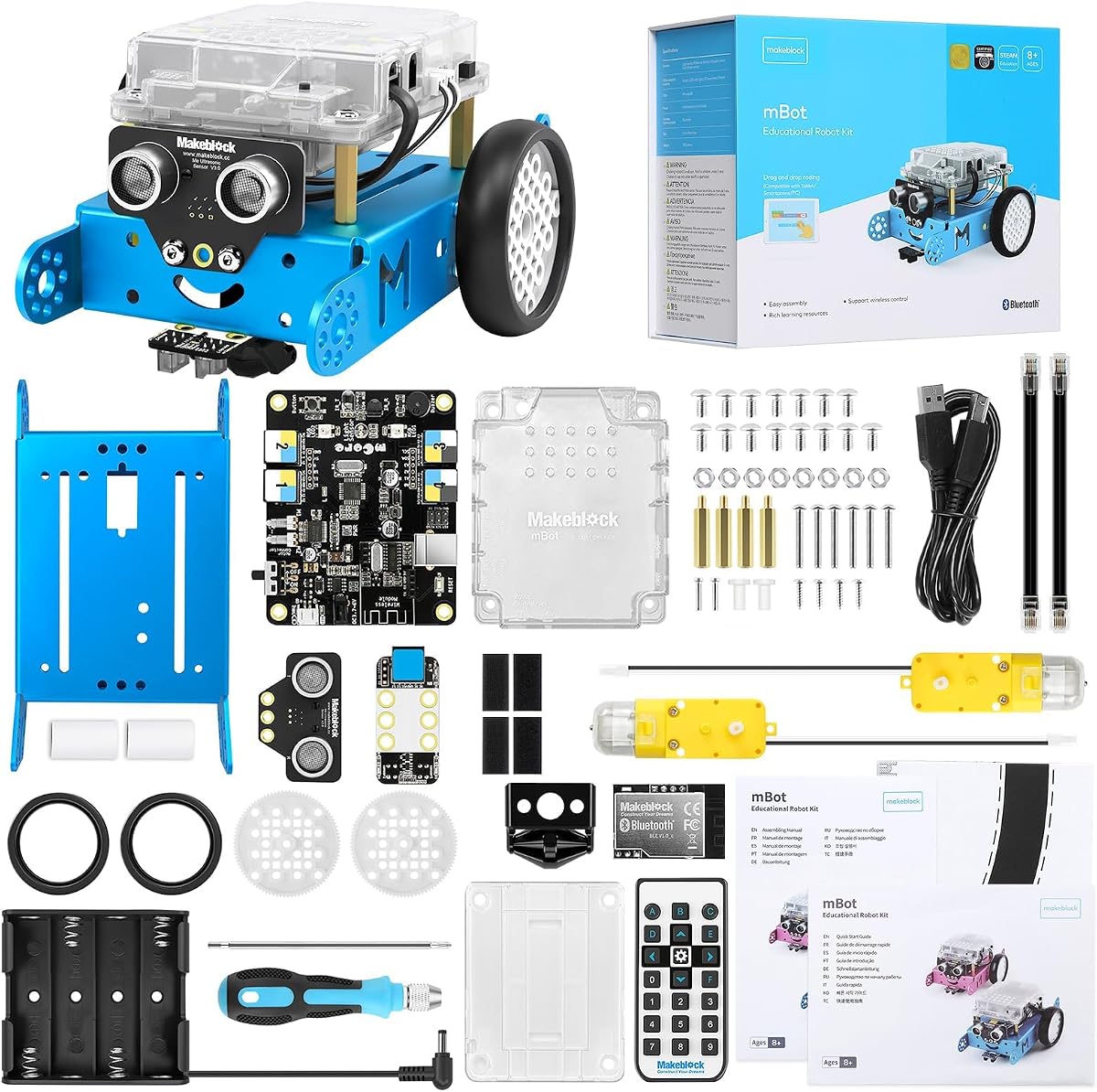
This kit is designed specifically for younger learners transitioning from block coding to text based programming. It offers a sturdy metal chassis that withstands active play while teaching fundamental robotics concepts.
We may earn a commission when you buy through this link, at no additional cost to you.
The learning path is well structured starting with visual blocks and moving to Arduino IDE as skills develop. The included apps support remote control and interactive games that keep engagement high.
Build times are short allowing kids to start coding quickly. The metal frame adds durability but also requires precise assembly. Note that power sources must be purchased separately for full operation.
Choose this if you want a reliable educational tool that grows with the child. It is ideal for schools or home learning environments focused on STEM fundamentals.
Students start with drag and drop blocks before moving to C code for advanced control.
The aluminum alloy and plastic mix ensures longevity against drops and rough handling.
We may earn a commission when you buy through this link, at no additional cost to you.
This kit offers a robust tank design with metal tracks that handle varied terrain better than standard wheels. The adjustable camera mount allows for dynamic viewing angles during remote operation.
We may earn a commission when you buy through this link, at no additional cost to you.
The stainless steel chassis provides stability and durability for outdoor or heavy use scenarios. Five interactive modes ranging from FPV to obstacle avoidance make it versatile for different learning goals.
Assembly takes longer than wheeled kits due to the track system. The metal parts are durable but require careful handling during build. It is an investment in long term project value.
Ideal for users wanting a rugged robot capable of navigating rough surfaces. This kit suits hobbyists who enjoy mechanical assembly and advanced control logic.
The metal tracks provide excellent traction on slopes and uneven floors.
Servo mounted cameras allow you to look up or down while driving.
We may earn a commission when you buy through this link, at no additional cost to you.
Building a self balancing robot introduces users to gyroscopic feedback and real time motor control. The two wheel design creates a fun toy that stands upright when powered on.
We may earn a commission when you buy through this link, at no additional cost to you.
Six different ways to play include remote control and auto follow modes. The LED effects add visual appeal to the mechanical movements. Example code helps beginners understand complex feedback loops.
Balancing requires a smooth surface to function correctly. The initial setup involves tuning parameters to find the right balance point. This adds depth to the learning experience.
Perfect for intermediate builders ready to explore dynamic stability. It transforms standard car kits into something more complex and engaging.
Real time sensor data keeps the robot upright against minor disturbances.
Switch between remote, auto follow, and obstacle avoidance for variety.
We may earn a commission when you buy through this link, at no additional cost to you.
This kit stands out for its omnidirectional Mecanum wheels that allow side to side movement. Such capability is rare in consumer robotics and offers unique navigation possibilities.
We may earn a commission when you buy through this link, at no additional cost to you.
The expansion packs allow upgrades to robotic arms or solar power. This modularity extends the life of the kit as interests evolve. Tutorials focus on story driven scenarios to engage students.
Voice recognition adds a modern AI touch to the project. It requires specific app setup and additional sensors. Ensure you have the necessary batteries before starting the build.
Best for tech enthusiasts wanting unique movement capabilities. The modular design supports long term exploration and creative upgrades.
Four angled rollers enable sideways and diagonal travel in any direction.
Expansion packs let you add arms or solar panels later.
We may earn a commission when you buy through this link, at no additional cost to you.
This kit delivers FPV capabilities at a lower price point than competitors. The ESP32-S3 module ensures stable WiFi connection for streaming and control.
We may earn a commission when you buy through this link, at no additional cost to you.
Open source libraries simplify the coding process significantly. You can access free tutorials online to get started immediately. The chassis is straightforward but functional.
Self assembly is required which builds logical thinking skills. While not as robust as metal options it works well for learning. It is a smart choice for budget conscious buyers.
Ideal for beginners prioritizing cost without sacrificing core features. It proves that affordable kits can still offer advanced connectivity.
Get camera streaming and WiFi control without paying premium prices.
Open source resources provide free code examples and tutorials online.
We may earn a commission when you buy through this link, at no additional cost to you.
This kit allows building four different robot configurations including a tank and an arm. The modular design encourages creativity and problem solving across different projects.
We may earn a commission when you buy through this link, at no additional cost to you.
The robotic arm has five degrees of freedom for precise manipulation. It combines mechanical engineering with coding in a single package. Video tutorials guide users through each specific build.
Assembly complexity is higher due to multiple distinct models. It suits older teens looking for a challenge. Ensure you have time for multiple builds to maximize value.
Best for households wanting variety in their STEM projects. The ability to transform one kit into multiple models is a significant plus.
Mix and match parts to create different robot styles easily.
Five degrees of freedom allow complex gripping tasks.
We may earn a commission when you buy through this link, at no additional cost to you.
This is a comprehensive learning platform rather than a single vehicle. It includes hundreds of items for various projects from simple LEDs to complex IoT applications.
We may earn a commission when you buy through this link, at no additional cost to you.
Video courses and expert guides support the hardware deeply. It is designed to teach the fundamentals of electronics before moving to robotics. The car mode is just one of many projects.
It requires more setup time than preassembled kits. The sheer volume of parts might be overwhelming initially. However it offers the most comprehensive education of all options.
Choose this if you want a broad electronics education. It serves as a long term resource for all STEM learning.
Comprehensive courses teach you about electronics before assembly.
Access over eighty projects to practice different skills.
We may earn a commission when you buy through this link, at no additional cost to you.
This is a high end kit using industrial grade aluminum parts. It supports up to ten different models including complex robotic arms and tanks.
We may earn a commission when you buy through this link, at no additional cost to you.
The MegaPi controller handles multiple motors and sensors simultaneously. Python compatibility allows older users to use professional programming languages. It scales with your growing expertise.
The premium price is offset by the quality of parts. It is built for long term use without wear. Expect a longer assembly process for the detailed parts.
Ideal for serious makers or advanced students. It is a professional tool that inspires serious innovation and engineering.
Aluminum alloy parts ensure durability and precision over years.
Support for Python opens the door to machine learning applications.
We may earn a commission when you buy through this link, at no additional cost to you.
This kit offers a unique legged design that walks rather than rolls. Each leg has three motors allowing for complex movements like crawling and twisting.
We may earn a commission when you buy through this link, at no additional cost to you.
The remote is included making it ready to use with batteries. Tutorials are available online but not printed in a box. It works on multiple operating systems.
Assembly requires precision as the leg servos must align correctly. It is more complex than wheeled kits but very rewarding. Battery costs add to the total budget.
Best for those interested in biomimicry and advanced movement. It teaches a different set of engineering skills compared to standard cars.
Six legs with independent motors allow unique walking gaits.
Pre-written code simplifies learning to control complex movements.
We may earn a commission when you buy through this link, at no additional cost to you.
Selecting the right kit requires considering your skill level, desired features, and budget.
Entry level kits are best for ages eight to twelve with simple block coding. Advanced kits suit teens and adults who prefer text based programming.
Always check age recommendations to ensure the build process matches the learner's abilities.
Most kits offer remote control app control or both. Some support advanced features like FPV streaming for a first person view.
Choose a control method that fits your play style and device availability.
Wheeled robots are easier to build and drive while tank treads offer better traction on uneven surfaces. Legged robots provide unique movement but are harder to assemble.
Consider where you will operate the robot to choose the right movement system.
Common sensors include ultrasonic for obstacle avoidance and infrared for line tracking. More expensive kits might include cameras or gyroscopes.
A wider range of sensors allows for more complex and interactive projects.
Look for kits that support add on packs like robotic arms or additional sensors. Modular systems grow with your skills.
A modular approach provides better long term value than static kits.
Metal chassis offer durability while plastic is lighter and cheaper. Check the build materials to understand how tough the robot will be.
Durable materials ensure the robot lasts through many projects.
Some kits include rechargeable batteries while others require you to buy them separately. Always check if batteries are included before purchasing.
Ensure you have the correct battery type ready for the first build.
Kits with active online communities provide troubleshooting help and code examples. Look for brands with extensive documentation.
Strong community support makes solving build issues much easier.
Always assemble the chassis carefully following the instructions to avoid loose parts. Secure all wires tightly to prevent disconnection during movement.
Charge batteries fully before first use and monitor them during operation to prevent overheating. Store batteries in a cool dry place when not in use.
Update your software or firmware regularly to access new features and security patches. Keep the robot clean from dust and debris to ensure sensors work correctly.
Most of the kits listed are designed for solderless assembly using plug-in connectors. Some advanced models might require minimal soldering but it is rare for beginners. Always check the product details for assembly requirements.
Yes, most modern kits include app support for iOS and Android. This allows you to control movements and view camera feeds directly from your phone. Ensure your device meets the app requirements.
Many kits exclude batteries to save weight and cost. Some include rechargeable packs for the robot but not for remotes. Always check the package contents before purchasing.
Beginner kits often start with block coding like Scratch and transition to C++ via Arduino IDE. Advanced kits might support Python or other languages. The learning path usually starts simple.
Some kits support modular expansion packs that add arms or sensors. Mixing different brands is harder due to compatibility issues. It is best to stick to one ecosystem.
A smooth flat surface like a floor or table is ideal. Avoid uneven terrain unless you have a tank kit. Indoor testing is safer for delicate electronics.
We highlighted the ELEGOO UNO R3 as the top choice for its balanced features and ease of use. The LAFVIN R3 offers great value for those on a budget while the Makeblock mBot Ultimate stands out for premium builders.
Prioritize a kit that grows with your skills so you can keep using it as you learn. Modular and expandable options offer the best long term learning experience.
Remember to check current availability and shipping details before ordering. We hope this guide helps you find the perfect robot for your next project.