
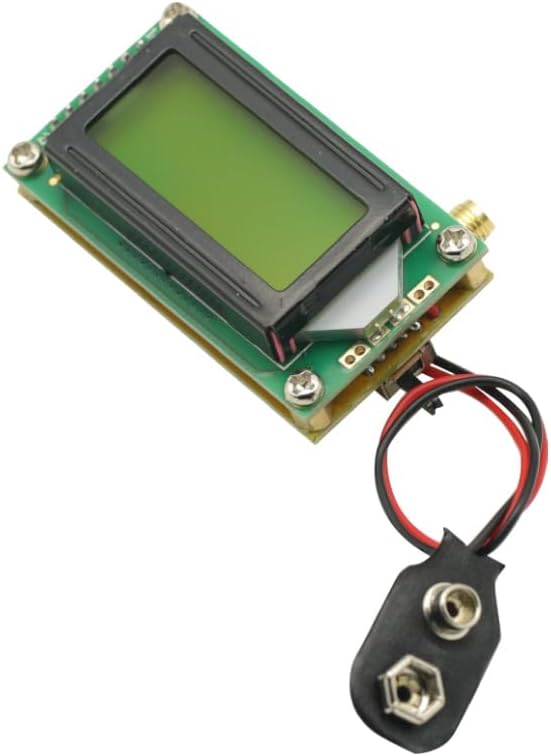
Acxico 1 Pcs High Accuracy
3.1Editor score
Affordable entry level option
Simple LCD display
Compact module size
This guide compares the top ten frequency counter for ham radio tools available today, evaluating accuracy, range, and features to help you choose the right
Finding the right frequency counter for ham radio is essential for anyone serious about maintaining accurate transmissions. Whether you are tuning a CB unit or calibrating a high performance HF rig, precise measurement ensures compliance and optimal signal clarity across all bands.
We evaluated ten distinct models ranging from budget friendly handheld units to advanced professional grade analyzers. Our comparison focuses on frequency range coverage, measurement accuracy, ease of use, and additional features like decoders or spectrum analysis capabilities to suit various needs.
Each pick below highlights specific strengths and ideal use cases for different operators. Please note that availability and pricing may fluctuate over time, so always verify current details before making your final purchase decision for your specific amateur radio setup.
3.1Editor score

4.1Editor score

5.0Editor score
The following table provides a side by side overview of all ten frequency counter for ham radio models reviewed in this guide to help you quickly compare key specifications and capabilities.


The Mcbazel Surecom SF401 Plus stands out as a versatile tool for measuring continuous carrier signals from two way radios. It offers a broad frequency range that suits most common ham radio bands while maintaining a small size easy for field work.
We may earn a commission when you buy through this link, at no additional cost to you.
Its use of a temperature compensated crystal oscillator ensures that measurements remain stable across varying environmental conditions. The included CTCSS decoder helps users identify tone squelch codes quickly, which is useful during troubleshooting or identifying signals.
While it is not designed for wide bandwidth analysis, it excels at pinpointing specific transmission frequencies with reliable accuracy. The four button interface makes it straightforward to operate even for beginners who need quick results without complex menus.
This unit is an excellent choice for hobbyists and technicians who need a reliable portable counter for general maintenance tasks. It provides a solid balance of features and affordability that fits well in most ham radio toolkits.
Measuring from 27MHz to 3000MHz allows this device to handle everything from CB bands to higher UHF applications with ease.
The temperature compensated oscillator maintains precision between -45 C and 65 C, ensuring reliable readings in diverse operating environments.
We may earn a commission when you buy through this link, at no additional cost to you.
The Surecom SF401 Plus offers a practical solution for measuring walkie talkie frequencies with a signal strength indicator to help users assess transmission quality. Its design focuses on simplicity and portability for everyday testing needs.
We may earn a commission when you buy through this link, at no additional cost to you.
Users benefit from a clear interface that allows quick selection of frequency ranges to match the two way radios they are testing. The small form factor makes it easy to carry in a bag or toolkit during field operations.
While it lacks some advanced decoding features found in newer models, it remains effective for basic frequency verification tasks. The signal strength indicator adds a layer of diagnostic capability that aids in antenna tuning and setup.
This model is ideal for users who need a straightforward and reliable counter without unnecessary complexity. It serves well for maintaining radio equipment where accurate frequency confirmation is the primary requirement.
Visual feedback on signal strength helps operators gauge the quality of a transmission while testing portable radios.
Designed to be carried anywhere, this unit supports on the go maintenance and quick field checks with ease.
We may earn a commission when you buy through this link, at no additional cost to you.
The FC-2800M is built to handle a wide array of two way radio signals including modern digital modes like DMR. It provides a digital mode that simplifies the process of identifying specific frequencies in busy radio environments.
We may earn a commission when you buy through this link, at no additional cost to you.
One of its strongest features is the inclusion of a two year warranty which offers peace of mind for buyers investing in testing equipment. The built in CTCSS decoder further enhances its utility for users working with tone based systems.
Although the interface is simple, it is designed to be intuitive so users can start testing immediately without extensive training. The high accuracy crystal time base ensures consistent results even during prolonged use in varying conditions.
This counter is a solid option for those who want reliable performance across CB amateur and DMR bands without spending excessively. Its warranty and support for modern signals make it a practical choice for many hobbyists.
Digital mode capability allows users to measure frequencies associated with DMR radios effectively.
A two year warranty provides assurance that the product will perform as expected over time.
We may earn a commission when you buy through this link, at no additional cost to you.
The TinySA Spectrum Analyzer goes beyond simple frequency counting by offering full spectrum analysis within its operating range. This capability is particularly valuable for identifying interference or visualizing signal distribution across bands.
We may earn a commission when you buy through this link, at no additional cost to you.
Its built in signal generator allows users to generate test tones for calibration or antenna tuning tasks without needing external equipment. The touchscreen interface provides an intuitive way to navigate complex analysis settings and view results clearly.
While it does not cover the full ham radio spectrum above 960MHz, it remains a powerful tool for HF VHF and UHF testing. The ability to connect to a PC via USB expands its functionality for remote measurements and data logging.
This device is best suited for operators who need deeper insight into their RF environment than a standard counter can provide. It bridges the gap between basic counters and professional laboratory analyzers at an accessible price point.
Viewing signals across a frequency band helps identify noise sources and optimize antenna performance efficiently.
A built in generator supports self calibration and testing without requiring additional hardware.
We may earn a commission when you buy through this link, at no additional cost to you.
This portable counter is designed specifically for testing within the common VHF and UHF amateur radio bands. Its focused range makes it an efficient tool for users who primarily work on local repeater and handheld radio frequencies.
We may earn a commission when you buy through this link, at no additional cost to you.
Operation is simplified with a one button interface that allows quick power on and frequency reading. The compact size ensures it can be kept in a small pocket or attached to a belt for immediate access during field work.
While it lacks the broad range of more expensive units, it delivers accurate measurements within its designated bands. The inclusion of a battery and antenna means it is ready to use right out of the package.
This model is ideal for budget conscious operators who need a dedicated tool for routine checks on specific frequencies. Its simplicity and portability make it a practical addition to a field kit for local testing.
Minimal controls reduce complexity and allow for rapid testing of handheld transceivers.
Its mini size makes it easy to carry and deploy for quick frequency checks anywhere.
We may earn a commission when you buy through this link, at no additional cost to you.
The Anysecu SF-103 builds upon the foundation of earlier models to offer an improved range and usability for radio enthusiasts. It maintains the familiar four button layout which helps users transition easily from other similar counters.
We may earn a commission when you buy through this link, at no additional cost to you.
Its range extends up to 2.8GHz which covers most common two way radio applications including modern digital systems. The signal strength indicator adds value by helping users assess the quality of a transmission while measuring frequency.
This unit is designed to be a reliable companion for maintenance personnel who need to verify frequencies quickly and accurately. Its small size ensures it can be carried comfortably during routine equipment checks and repairs.
For users looking to upgrade from older basic models, this counter provides a meaningful enhancement in range and features without a steep price increase. It balances performance and portability well for general ham radio use.
Covering from 2MHz to 2.8GHz ensures compatibility with a wide variety of radio types.
Real time signal strength helps confirm that a transmission is strong enough for testing.
We may earn a commission when you buy through this link, at no additional cost to you.
The Mcbazel Surecom SF-103 handheld offers robust frequency measurement capabilities with a built in battery level warning to prevent unexpected shutdowns. It uses TCXO technology to maintain stability across temperature variations during field use.
We may earn a commission when you buy through this link, at no additional cost to you.
Its range supports most amateur bands including 2m and UHF making it suitable for a wide array of testing scenarios. The four button control scheme is straightforward and allows for quick adjustments without deep menu navigation.
Users should note that the device prohibits direct access to radio antenna output to avoid damage which requires careful connection practices. Despite this limitation it remains a reliable tool for measuring transmission frequencies accurately.
This counter is a strong choice for technicians and hobbyists who need a rugged handheld option for regular maintenance. Its balance of accuracy and convenience makes it a worthwhile addition to any serious radio toolkit.
An indicator alerts users before power runs out to prevent interruptions during critical measurements.
Temperature compensation ensures that readings stay accurate even in hot or cold environments.
We may earn a commission when you buy through this link, at no additional cost to you.
This module provides a very basic frequency counting capability suitable for simple DIY ham radio projects. It uses a straightforward LCD display to show frequency values within its operating range of one to five hundred MHz.
We may earn a commission when you buy through this link, at no additional cost to you.
While the precision is limited compared to commercial handheld units it serves well for educational purposes or internal circuit testing. Its compact PCB design makes it easy to integrate into custom setups where space is tight.
Users should be aware that the accuracy can only be adjusted to the second digit of the decimal point which limits its utility for professional tuning. It is best used as a reference tool rather than a primary calibration device.
For hobbyists building custom equipment who need a low cost way to verify signal presence this module is a practical option. It offers a functional entry point into frequency measurement without requiring significant investment.
Its small size allows integration into custom boards or small test benches easily.
Digital LCD output provides clear visibility of frequency data for quick checks.
We may earn a commission when you buy through this link, at no additional cost to you.
This board serves as a basic frequency meter component ideal for inclusion in ham radio kits or simple test setups. It includes an LCD display to show readings directly and operates with low power consumption for efficiency.
We may earn a commission when you buy through this link, at no additional cost to you.
The design is straightforward with a focus on providing frequency data within the 1MHz to 500MHz range. It is a useful part for builders who want to add measurement capability to their projects without complex electronics.
Users should note that it is sold as a board which may require some assembly or integration into a larger device. While it lacks advanced features it fulfills the basic need of measuring low to mid frequency signals.
For those working on educational projects or basic homebrew equipment this counter board offers a budget friendly solution. It provides a functional way to monitor frequency without needing a complete standalone unit.
Efficient operation makes it suitable for battery powered or portable test setups.
Built in screen allows immediate viewing of frequency values without external tools.
We may earn a commission when you buy through this link, at no additional cost to you.
The AURSINC TinyGTC represents the pinnacle of portable frequency counting with GPS disciplined oscillator technology for unmatched stability. It supports measurements from 0.1Hz to 7GHz offering comprehensive coverage for advanced amateur and professional needs.
We may earn a commission when you buy through this link, at no additional cost to you.
Its dual channel design allows simultaneous measurement of two signals while high resolution analysis tools like FFT and ADEV provide deep insight into signal quality. The large touchscreen simplifies navigation through these sophisticated functions.
This unit is tailored for serious enthusiasts who require lab grade precision for SDR tuning or calibration tasks. The inclusion of SD card storage and SCPI control ensures data can be logged and analyzed later.
For users needing the highest accuracy available in a portable form factor this counter justifies its investment with features that surpass standard models. It is the ideal companion for precise station calibration and research projects.
GPS locking ensures long term frequency stability for accurate measurements over time.
FFT and ADEV analysis offer detailed signal characterization beyond simple frequency readings.
We may earn a commission when you buy through this link, at no additional cost to you.
Selecting the right frequency counter for ham radio depends on understanding your specific measurement needs and budget constraints.
Ensure the counter covers the bands you operate on frequently such as HF VHF and UHF. Some models only cover specific segments while others offer broad spectrum from 27MHz to 7GHz.
Choose a model that spans your primary operating frequencies to avoid limitations during testing.
Look for devices with TCXO or GPSDO technology to maintain precision across temperature changes. Accuracy is critical for tuning oscillators and verifying transmissions to avoid interference.
Higher accuracy tools are essential for calibration tasks where small frequency errors can cause issues.
Models with CTCSS or DCS decoders help identify tone codes quickly during signal analysis. This is useful for distinguishing between radios that share the same frequency but use different squelch tones.
Decoders save time when troubleshooting or organizing signals in busy environments.
Portable handheld counters are ideal for field work while benchtop units suit home stations. Consider how often you need to carry the device and whether battery operation is required.
Compact designs make it easier to take measurements anywhere without setup delays.
Clear LCD or touchscreen displays improve readability and ease of navigation through menus. Simple button interfaces are better for quick checks while complex screens offer more analysis data.
An intuitive interface reduces the learning curve and speeds up your workflow.
Verify that the device has safeguards against overvoltage to prevent damage from direct antenna outputs. Direct connection to high power transmitters can destroy sensitive components inside the counter.
Proper connectors and warnings protect your investment and ensure safety during testing.
Features like signal generators spectrum analysis or USB connectivity expand the utility of the counter. Decide if you need extra tools for calibration or data logging based on your projects.
Advanced features can replace multiple tools and streamline your testing process.
Check for warranty terms and customer support availability to ensure peace of mind with your purchase. A good warranty indicates confidence in the product quality and longevity.
Reliable support helps resolve any technical issues that arise during use.
Always connect the antenna or input probe to the correct port before powering on the device to prevent signal loss. Ensure the input level matches the device specifications to avoid overloading internal circuits.
Regularly calibrate your unit using a known reference source if possible to maintain accuracy over time. Periodic calibration checks ensure that readings remain reliable after long periods of inactivity.
Store the counter in a dry and temperature stable environment to protect its internal components from humidity and extreme heat. Keeping it in a padded case during transport prevents physical damage to the display and ports.
A frequency counter for ham radio measures the exact transmission frequency of radios to ensure accuracy and compliance. It helps operators verify that equipment is transmitting on the correct channels to avoid interference and maintain signal clarity.
Many modern frequency counters support digital modes like DMR by detecting continuous wave signals within the digital transmission. Check the product specifications to confirm digital compatibility if you use digital radios primarily.
A GPS disciplined oscillator is ideal for calibration tasks requiring extremely high stability but not always necessary for basic frequency checks. Standard TCXO models provide sufficient accuracy for most hobbyist and routine maintenance needs.
A CTCSS decoder identifies tone squelch codes transmitted by radios to help differentiate between signals on the same frequency. This feature is useful for troubleshooting and organizing repeater and simplex operations.
For most amateur radio applications a accuracy within a few parts per million is sufficient. High end models offer better precision for calibration but standard counters serve well for everyday transmission verification.
A spectrum analyzer provides a broader view of signal distribution and interference but may not offer the same frequency precision as a dedicated counter. They serve different purposes depending on whether you need analysis or exact frequency measurement.
The ten options reviewed provide a wide range of choices from basic modules to advanced analyzers suitable for every level of operator. Selecting the right one ensures you can maintain your station with confidence and accuracy.
Prioritize models that cover your primary bands and offer stable measurement technology like TCXO or GPSDO. Consider portability and ease of use based on whether you work mainly in the field or at home.
Verify current availability and support details before finalizing your purchase to ensure you get the best value for your needs. Choosing the right counter will enhance your ability to troubleshoot and optimize your radio setup.