
NOYAFA NF-488 POE Cable Tester
4.5Editor score
Backlit LCD screen
Detects POE standards
RJ45 continuity testing
This guide compares the top inline POE testers for network engineers, covering features like voltage readings, cable continuity, and standards compliance to
Finding the right inline POE tester is crucial for network professionals who need to verify power delivery across Ethernet cables. These tools help identify voltage issues, check compatibility with various standards, and ensure powered devices receive stable energy without interrupting data flow during installation or maintenance tasks.
We evaluated ten leading models based on their testing accuracy, ease of use, and support for modern standards like 802.3af/at/bt. Our analysis included factors such as display clarity, battery requirements, and the ability to detect both standard and non-standard passive PoE configurations common in diverse network environments today.
Each selection below highlights specific strengths and limitations to help you match a tool to your workflow needs. While ratings reflect user feedback, real-world performance can vary. Always check current availability and pricing before purchasing to ensure you get the best value for your specific networking requirements.
4.5Editor score
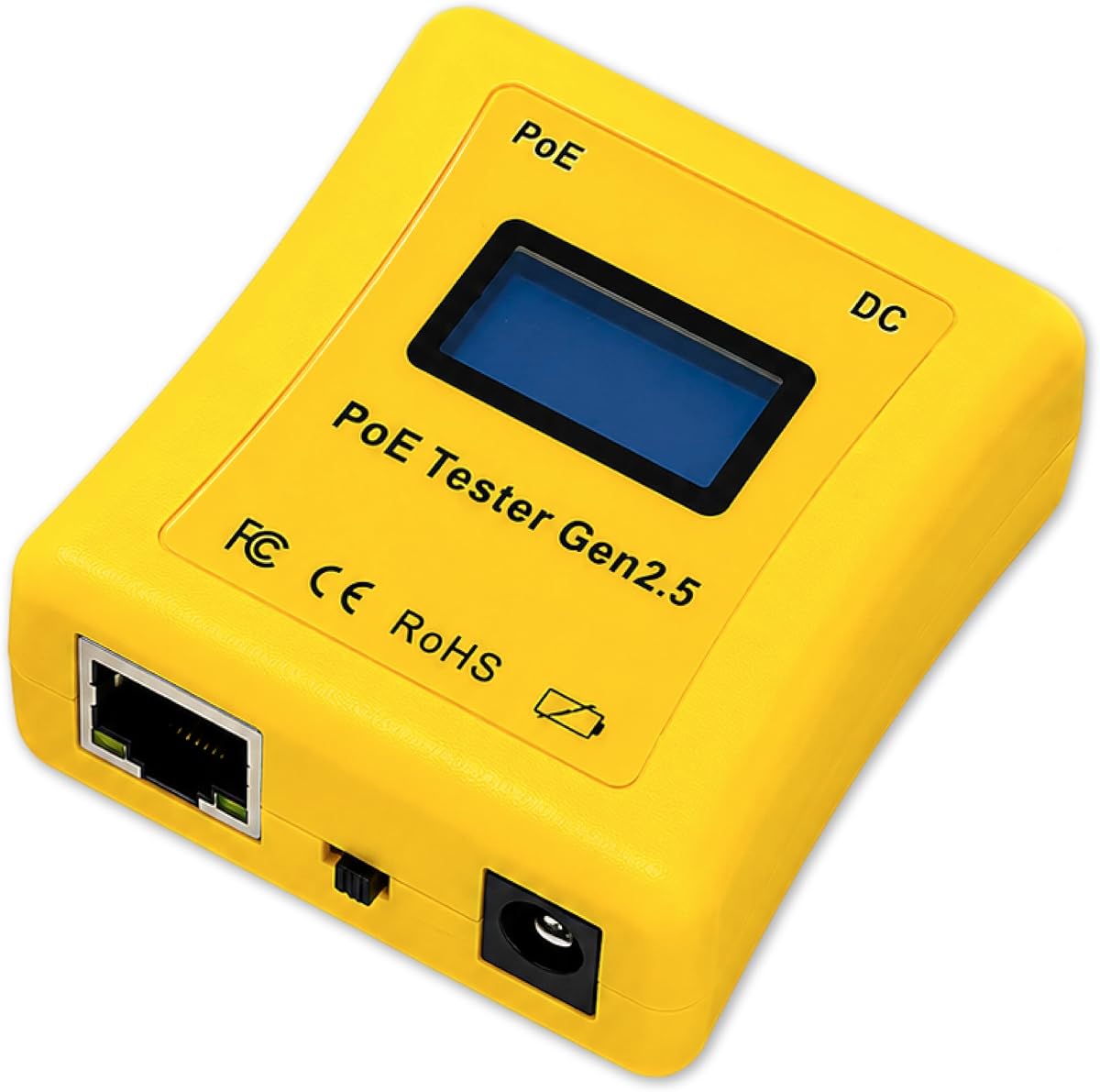
4.3Editor score

4.1Editor score
This table provides a quick side-by-side overview of the top ten inline POE testers available this month. Compare key specifications like testing modes, voltage ranges, and display types to find the model that best fits your technical requirements.



The PoE Texas Power Over Ethernet Voltage and Current Tester stands out as a top choice for professionals needing reliable diagnostics without dependency on external power sources. With a solid 4.3 star rating, it delivers consistent performance for checking voltage and compatibility before installing devices like cameras or VOIP phones.
We may earn a commission when you buy through this link, at no additional cost to you.
Its standout feature is the Simulate PoE Device mode, which allows you to test managed or auto-negotiating switches without attaching a powered device. This capability saves time by letting you activate ports on AF/AT/BT switches and observe power loss in cables accurately. Additionally, the ergonomic curved body is 25 percent smaller than previous models, making it easier to hold during extended field work.
While the device is compact, it still handles robust measurements, displaying Mode A and Mode B voltages and cycling through voltage, current, and power readings automatically. The only trade-offs are the lack of a separate remote probe for extended testing and relatively less brand recognition compared to legacy tools. However, these factors are acceptable given its self-sufficient operation and precise data output.
This tool is ideal for IT professionals and network technicians who need an infinite usage device that draws power directly from the POE line. If you want to reduce downtime and ensure your powered devices receive adequate energy without interruption, this tester offers the best balance of portability and functionality currently available.
Because it draws power from the POE line, you never need to charge or replace batteries during critical field jobs.
The simulate mode lets you diagnose switch-side power issues even when a powered device is not physically present.
We may earn a commission when you buy through this link, at no additional cost to you.
The PoE-T100 Inline DC and PoE Tester Tool is designed for installers and engineers who demand high-visibility displays and precise power readings. Its bright OLED screen presents real-time voltage, current, and power measurements on a single page, allowing for instant identification of PSE types and power levels during diagnostics.
We may earn a commission when you buy through this link, at no additional cost to you.
This model supports three distinct modes: PD Mode to simulate a powered device up to 802.3bt, Inline Mode for pass-through testing between PSE and PD, and DC Mode for measuring non-PoE power sources. It accurately differentiates between standard 36 to 57 volt and non-standard 12 to 57 volt passive PoE, ensuring compatibility with diverse network setups. The self-powered operation means it draws energy directly from PoE or DC supplies, eliminating the need for external batteries.
Although it comes at a slightly higher price point than basic testers, the detailed data and clarity justify the cost for professional environments. Some users might find the DC mode features complex if they only work with standard switches, but this versatility is crucial for comprehensive troubleshooting. The OLED display is particularly beneficial in low-light conditions where other screens might struggle to provide clear readings.
Choose this tool if you need a premium experience with immediate visual feedback and support for both standard and non-standard power configurations. It accelerates installation and reduces misconfigurations by providing critical power data instantly, making it a valuable asset for any network technician's toolkit.
The OLED screen ensures you can read measurements clearly even in dark server rooms or outdoor installations.
Switching between PD, Inline, and DC modes allows one tool to handle a wide variety of power scenarios.
We may earn a commission when you buy through this link, at no additional cost to you.
The NOYAFA NF-488 is an excellent option for technicians seeking an affordable yet reliable tool for detecting PoE and checking network cable continuity. It has earned a 4.5 star rating due to its ability to identify standard and non-standard POE information, including voltage standards and power polarity, at a budget-friendly price point.
We may earn a commission when you buy through this link, at no additional cost to you.
This multifunctional tester is primarily used for low-voltage systems like security monitoring and communication lines. It features a large LCD backlit screen that makes results clear at a glance, even in dimly lit areas. The device can test for open circuits, short circuits, and crossovers in network cables, which reduces troubleshooting time significantly for those with frequent testing needs.
While it lacks some of the advanced monitoring features found in premium models, it covers essential tasks effectively. The voltage test range goes up to 60V, which is sufficient for most standard and passive PoE applications. The casing includes an anti-slip effect to prevent drops during use, ensuring durability despite the lower cost.
If you are looking for a cost-effective solution to verify cable integrity and PoE presence without breaking the bank, the NF-488 is a top recommendation. It strikes a good balance between functionality and price, making it accessible for smaller contractors or those new to network installation.
Get reliable PoE detection and continuity testing without investing in high-end expensive equipment.
The backlit screen ensures you can see wiring results clearly in any lighting condition.
We may earn a commission when you buy through this link, at no additional cost to you.
The TRENDnet TC-NTP1 is designed for professionals who need an NDAA compliant tester for government or secure installations in the U.S. and Canada. It offers battery-free operation and supports testing for 4PPoE, PoE+, and standard PoE devices with gigabit port connectivity.
We may earn a commission when you buy through this link, at no additional cost to you.
It features three distinct testing modes: T-mode for testing PSE devices to determine supported standards, N-mode for non-standard passive devices, and I-mode for inline testing of voltage, amperage, and wattage. A convenient step button allows you to cycle through readouts or lock the display to a specific value for real-time monitoring.
While the interface is straightforward, it may lack the advanced graphical displays found in newer models. The NDAA compliance is a significant advantage for regulated sectors, but this limits its availability in other regions. The two-year manufacturer protection adds value and peace of mind for commercial deployments.
If you work on government contracts or require certified compliance, this is a trustworthy choice. It provides the essential data needed for stable PoE delivery without unnecessary complexity, making it a solid tool for regulated environments.
NDAA compliant status ensures suitability for government and regulated network installations.
Lock the display to monitor specific wattage readings continuously during device operation.
We may earn a commission when you buy through this link, at no additional cost to you.
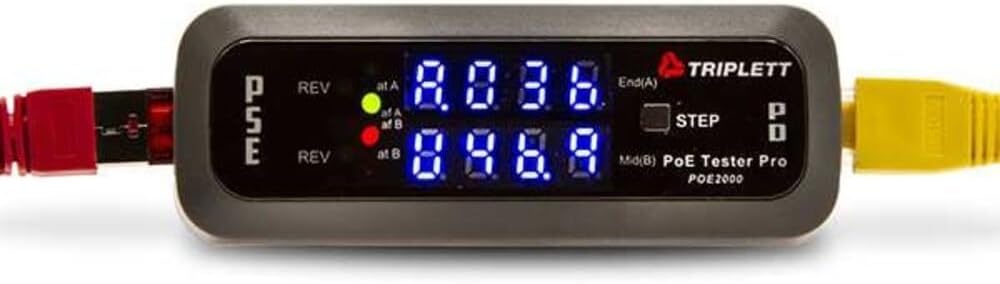
The Triplett POE2000 is a classic inline detector that uses dual 7-digit LEDs to indicate power source and polarity. It is useful for quickly identifying whether a power source is End Span, Mid Span, or across all four pairs.
We may earn a commission when you buy through this link, at no additional cost to you.
Two yellow LEDs specifically indicate reversed polarity, helping prevent damage during installation. When used inline, the display alternates between Voltage, Current, and Power with a step button for selecting specific data to show. It can determine standard PoE or non-standard passive PoE efficiently.
Although it has a lower rating compared to newer models, it remains functional for basic detection tasks. The LED interface is simple but may be less informative than OLED displays. Users who prefer a physical brand might still find it reliable for quick checks.
This model is suitable for those who need basic polarity and span detection without complex features. It serves as a robust backup tool for quick field inspections where detailed readouts are not strictly required.
High-visibility LEDs allow for quick checks even in bright outdoor lighting.
Yellow LED indicators warn of reversed polarity to prevent device damage during connection.
We may earn a commission when you buy through this link, at no additional cost to you.
The Triplett POE3000 is an updated inline power tester that helps speed up installation and troubleshooting for PoE system devices. It features four LEDs indicating IEEE 802.3af or 802.3at/bt standards, and two yellow LEDs for reversed polarity detection.
We may earn a commission when you buy through this link, at no additional cost to you.
It detects PSE type, class, power source, and voltage levels. The device also shows whether the source is End Span, Midspan, or across all four pairs. The display alternates between Voltage, Current, and Power for inline level monitoring.
As a newer model, it has limited review data. However, its visual indicators offer clear feedback for standard PoE compliance. The design aims for simplicity and accuracy in routine checks.
Consider this for those preferring visual standard indicators over digital readouts. It is effective for verifying IEEE compliance quickly without navigating complex menus.
Four LEDs provide immediate visual confirmation of 802.3af/at/bt compliance.
Clear indicators simplify the process of checking port power states during setup.
We may earn a commission when you buy through this link, at no additional cost to you.
The Jonard Tools POE-1 offers comprehensive PoE testing for voltage, amperage, and standards. It supports passive and 802.3af/at/bt standards. It includes a kit for cable continuity verification for Cat5 to Cat6a cables.
We may earn a commission when you buy through this link, at no additional cost to you.
It uses battery-free operation via PoE or includes AA batteries for unpowered cables. The package comes with a remote, adapter, and manual. This completeness makes it convenient for field teams.
While ratings are not available, the kit approach is practical for diverse testing needs. It ensures you have all parts for both power and data checks in one box.
Ideal for teams that need a complete set without sourcing extra accessories separately. It is a good fit for general infrastructure testing requiring both power and continuity data.
Receive all necessary tools including adapters and remotes in one package.
Use it with or without batteries depending on whether PoE is available.
We may earn a commission when you buy through this link, at no additional cost to you.
This IEEE 802.3af/at/bt compliant network tester offers comprehensive PoE testing plus cable length measurement up to 300 meters. It identifies shorts, opens, and miswires effectively. The rechargeable battery supports extended field use.
We may earn a commission when you buy through this link, at no additional cost to you.
It features port flash detection to locate active ports and power load testing for validation. You can set customizable auto-shutoff times to save energy. The low-battery indicator helps maintain readiness.
The ability to measure cable length makes it unique among standard testers. While you need to charge the battery, the convenience of not needing disposables is a plus.
Choose this if you need to verify cable run lengths alongside power delivery. It is highly rated for reliability and offers a comprehensive suite of testing tools.
Measure cable lengths up to 300 meters to verify installation standards quickly.
Auto-shutoff settings ensure the battery lasts long during extended field sessions.
We may earn a commission when you buy through this link, at no additional cost to you.
The Inline Cat5/6 DVM and Network PoE Tester combines a DVM power panel with network testing features. It supports CAT5 and CAT6 types and provides voltage display for accurate readings.
We may earn a commission when you buy through this link, at no additional cost to you.
This device allows for inline network checks and power measurements. It is useful for older setups where digital interfaces are limited. The panel style offers a straightforward display.
Given its age, reviews are limited. However, DVM integration can be useful for precise voltage checks without separate tools.
It is suitable for legacy environments needing DVM functionality integrated with Ethernet checks. Keep in mind newer tools may offer more modern convenience.
Integrated DVM panel offers precise voltage measurements alongside network tests.
Works well with older CAT5/6 networks requiring direct DVM-style readings.
We may earn a commission when you buy through this link, at no additional cost to you.
This NF-488 Network Cable Tester and POE Cable Tester checks for short circuits, crossovers, and open circuits. It supports CAT5e/6 types. The included LED lamp helps illuminate dark spaces during testing.
We may earn a commission when you buy through this link, at no additional cost to you.
It performs loop-back tests to diagnose loop issues. It tests current, voltage, and power for DC appliances. The service promise includes lifetime friendly support and 24-hour reply.
The LED lamp adds practical value for dark wiring closets. While advanced data is limited, it handles common tasks well. Service quality is a strong selling point.
Use this for general network diagnostics with added light assistance. It is reliable for finding root causes of poor network performance quickly.
The included LED lamp allows you to see cable connections in dim environments.
Lifetime friendly service and 24-hour response ensure you get help when needed.
We may earn a commission when you buy through this link, at no additional cost to you.
Selecting the right tester requires understanding your specific needs for accuracy, display quality, and testing modes. Below are key factors to evaluate before purchasing.
Check if the tester supports Inline, PD, and DC modes based on your work. PD modes simulate devices to test switches. Inline modes let you check real power in cables without interruption.
Prioritize tools that cover the standards you encounter most in your daily tasks.
Look at the screen type like LCD or OLED. OLED screens offer better visibility in low light. LCDs with backlights are standard and cost-effective.
Choose a display that ensures readable data even in dark server rooms.
Decide between battery-free and battery-powered units. Battery-free units draw power from the PoE line so you never run out of battery. Battery units may work on non-PoE cables.
Battery-free is preferred for long field jobs where recharging is inconvenient.
Verify the voltage range supports your equipment. Standard PoE uses 36 to 57 volts. Passive PoE might range from 12 to 60 volts.
Ensure the tool covers your maximum expected voltage to avoid damage.
Check if the ports support Gigabit speeds. Some testers limit data to 100Mbps. Modern networks need Gigabit support for accurate data testing.
Gigabit ports prevent bottlenecks when testing high-speed switches.
For government work, look for NDAA compliance. This ensures the device meets legal security standards. Non-compliant tools might not be allowed on federal projects.
Verify compliance requirements for your specific client or region before buying.
Consider the size and weight. Lightweight models fit in pockets easily. Ergonomic designs reduce fatigue during extended use.
Choose a compact unit if you carry it daily in a toolkit.
Review warranty periods for protection. Two-year warranties are common. Longer terms indicate better manufacturer confidence.
Select tools with good support to protect your investment.
Begin by connecting the tester between your PSE source and the powered device. Ensure the network cable is firmly inserted to avoid loose connections. Turn on the device if required. Wait for the display to show initial readings. Observe voltage and current values to confirm they match your expected standards.
Use the step button to cycle through different data points like wattage or polarity. Lock the display if you need to monitor a specific value over time. For loop tests, ensure the remote is properly connected at the other end of the cable. Record any errors such as shorts or opens for documentation.
Store the device in a protective case to prevent physical damage. Avoid exposing it to moisture or extreme heat. Clean the ports with a soft brush if dust accumulates. Keep firmware updated if the model supports it. Regular care extends the lifespan and ensures consistent performance over time.
Many modern inline testers operate battery-free by drawing power from the PoE line. This means they function as long as the network provides power. Some models include battery options for non-PoE cables. Check the product description to confirm power requirements before purchase.
PD mode simulates a powered device to test if the switch provides power correctly. Inline mode sits in the cable path to monitor actual power delivery to a real device. You choose PD mode when you want to test the source without a device connected.
Some advanced models include time domain reflectometry to measure cable length. These are useful for verifying run distances during installation. Basic testers focus on voltage and current readings. Look for length measurement specs if you need this feature.
Yes, these testers are designed for live Ethernet connections. They handle voltage safely and allow you to test without interrupting data flow. Always follow the manufacturer's safety guidelines to prevent electrical hazards during installation.
Standard IEEE 802.3af/at/bt usually falls between 36 and 57 volts. Passive PoE can range from 12 to 60 volts. Ensure the tool supports your specific setup's voltage to avoid errors. Most tools list their max voltage clearly.
Many testers can detect non-standard passive PoE but may not guarantee compatibility. Check if the device specifically mentions non-standard support. Using incompatible power sources can damage devices. Always verify before connecting sensitive equipment.
Most devices display polarity visually using LEDs or text indicators. Two yellow lights often indicate reversed polarity. Understanding this helps prevent connecting wires incorrectly. Always check polarity indicators before finalizing connections.
NDAA compliance means the device meets specific security standards for U.S. government agencies. It is required for projects involving government infrastructure. If you work for federal contractors, ensure your tools are compliant.
We have reviewed ten top models offering various features for network professionals. The PoE Texas unit stands out for its battery-free operation, while NOYAFA offers value. The PoE-T100 excels with its OLED display.
When buying, prioritize features you actually need like gigabit support or specific modes. Avoid paying for advanced functions you will not use. Consider the environment where you will use the tool most often.
Remember that prices fluctuate. Always check the current pricing and availability before finalizing your purchase. Ensure you get the best deal for your specific networking needs.